During the late 80's and early 90's, a proxy war of sorts was being waged between the companies of Nintendo and Sega via their home video game consoles: Nintendo's Super Nintendo (known worldwide as the Super Famicom), and Sega's Genesis (known worldwide as the Mega Drive). 'Twas a war fought not with weapons, but with "bits." And from these "Bit Wars" came some of the finest games we know and play today. I've made it known before how the early-to-mid 90's were truly a golden age for gaming, as the 16-bit generation brought with it countless and timeless classics -- across all platforms. The competition between Sega and Nintendo was fierce, particularly in North America, and it made for a fascinating Console War that has yet to be outdone.
(Donlevy Note: I am well aware Sega and Nintendo weren't the only participants during this generation. I'd be ashamed of myself for not mentioning the ever under-appreciated TurboGrafx-16/PC Engine. There's no way in hell I'd forget that beast. Freaking Rondo of Blood, man! And there's also the Neo Geo, I suppose. I could buy myself a third arm for the price of that thing. Erhm...point being, those two are stories for another day...)
Of course, I'm not exactly an excellent source of first-hand experience from that time; I wasn't old enough to feel its full effects. This I admit! Yet, by the time I started to get into and learn more about these silly little wonderballs of awesomeness that are video games, the "Bit Wars" as we know them had come to an end -- and in its wake it left many, many, excellent games. Some became incredibly well known and sought after, while others would remain hidden gems, calmly waiting.
It's an incredible experience to find and enjoy a game fresh from an amazing era, and as a kid, I barely scratched the surface of what was out there. It's that combined feeling of accomplishment, wonder, awe, excitement, and unadulterated joy of playing and experiencing something that is at the same time a small piece of history, and a memory, that I strive for on my continued journey to play and understand a continually growing amount of retro games.
Well that, and they're still just so damn fun!
[Background yelling]
*Heeeeeey Donlevy, what's all that got to do with the ACTUAL ARTICLE?*
Yes, right, sorry. Anyway, just about everyone I played games with as a kid had a Super Nintendo...but it was rare that I ever saw an actual Genesis. As such, the games I played the most were undoubtedly Nintendo ones, but it also meant I was missing out on a whole library (and then some!). Indeed, the first time I ever played a Sonic the Hedgehog game was on the computer! Weird right?!? It was only a little later when I played on one of only a few Genesis (Genesi? Genesis's? Genesissssssssss...I don't know what the plural is) I had seen at the time, and realized two things: One, the controller was freaking huge, and Two, Sonic's native console was in fact the Genesis! It's strange to me when you consider that Sonic effectively became the mascot to rival Mario. I had no idea for a good while!
Oh and hey, let me know what console you grew up on! Were you a Sonic kid? Or a Mario kind a person? Or neither? Share your stories!
So years later, I'm continually learning about and playing a vast amount of Genesis games I am only now getting a chance to try. What immensely spurned this on a little while ago though, is a game collection called Sonic's Ultimate Genesis Collection.

Points for guessing the title, hehe.
You can get this collection of games on either the Xbox 360 or PS3...and it's freaking great! Not only is it a Platinum Hits and Greatest Hits respectively, making it super cheap(!), you get 40 Genesis games, as well as seven unlockable arcade games, and two unlockable Sega Master System games.
I can't recommend this collection enough if you have a fleeting interest in the Genesis, or retro games just in general. It's so cool! Ah, but I'm going to go a step further...and give you my thoughts and opinions on each included game!
*Audible groan*
Hey! No groaning! Imma educate you foo! Donlevy style. Haha. Anyway, here we go, alphabetically!

Alex Kidd in the Enchanted Castle

Welllllllllllllllll maybe I shouldn't have gone alphabetically. I have...mixed feelings on Enchanted Castle. It's a single player platformer where you run, jump, and kick as Alex Kidd, while collecting money and even defeating enemies in a rock, paper scissors minigame. The game looks great and colourful, especially for an early Genesis release, and there's some nice tunes to be had. At the same time, the controls are deceptive and slippery, and the enemy hit boxes are very uneven. And to make matters worse, you die instantly in one hit. Damn those cars to hell. You do get to control different vehicles as the game progresses, but you really need the patience to get there.
Bottom Line: It's Okay.
Alien Storm

Now we're talking! Based on the arcade game of the same name, Alien Storm is a beat 'em up side-scroller where you get to annihilate aliens with awesome weapons and explosions! Another person can join in, and the stages are divided up with small diversions ranging from store shootouts to running sections. The levels never feel like a drag. Despite its age, the gameplay holds up well, and the different characters add a balancing amount of flair and variety. But ultimately, the entire design of this game from the levels to the enemies in particular is just so freaking cool. Like most beat 'em ups, highly recommend playing with a friend.
Bottom Line: Lots of crazy fun!
Altered Beast

You'll notice a recurring trend with some these games is that they were first released in arcades. Altered Beast was one such game that ended up being a launch title for the Mega Drive/Genesis, and was included with the console during its beginning run (in 1989!). Altered Beast was meant to showcase how Sega could bring the arcade experience into your home via the Genesis, a big deal at the time, and I personally think it's a dang fine port (the original arcade release is included in the collection, so you can make your own judgment).
A side-scrolling action game, Altered Beast lets you punch and kick the minions of the dead in Ancient Greece as a centurion resurrected by Zeus. You proceed through the obstacles and monsters until reaching the stage end boss, but hopefully not before obtaining several floating orbs of power (POWER. UP.) from defeated enemies. Collecting them increases your BMI and power, and when collected three times turns the player into a ferocious beast, Animorph-style, depending on the stage, and each beast gets their own new and powerful attacks.
It's not a long game by any means, and the audio is a bit rough (even by Genesis standards; the Mega Drive/Genesis had a far weaker sound chip than the SNES) but I think its relevance and simplicity win out. And those transformations make you feel like a badass.
Bottom Line: RISE FROM YOUR GRAVE!
Beyond Oasis

Known as The Story of Thor abroad, Beyond Oasis is, well, essentially the Mega Drive's answer to The Legend of Zelda, as it shares many of its elements. Some might call it a clone, but I think that's just a little unfair to Beyond Oasis. The game has a really unique and colourful art style, accompanied with some sweet animations. As Prince Ali, you discover an armlet that you must power up by defeating various bosses. You get different weapons and elemental attacks (a la Zelda), and it plays like a solid adventure. It's not entirely memorable, but it is a good game in it's own right!
Vaguely reminds me a little of Illusion of Gaia as well.
Get this: the sequel on the Sega Saturn was called The Legend of Oasis in North America. Yeah.
Bottom Line: Not as good as Zelda, but still a good counterpart!
Bonanza Bros.

In Bonanza Bros., you get to steal stuff and flee the scene! Well, so long as you don't get caught. Playing as either Robo or Mobo, armed with a stun shooter, you make your way through the various houses/buildings and gather up different scores of loot for points. You have to avoid the police by running from them, stunning them, slamming doors on their face, or employing your partner (another player) to help you out. Get the loot and get to the blimp before the time runs out. Fairly straightforward, with only some stage elements and traps to adapt around.
The game has a really funky style and soundtrack, supposedly inspired by The Blues Brothers. Get a friend for this one!
Bottom Line: Hectic and addicting fun!
Columns

The Genesis/Mega Drive's answer to Tetris or Dr. Mario, Columns is fairly standard and straightforward, but better than some of the other clones out there. Three gems fall from the top of the screen, and you must turn them so they can be destroyed when matched with gems of the same type and colour either vertically, horizontally, or diagonally. The more levels you clear, the faster the game becomes. It can sometimes get more difficult than you might expect. Not much else to say about this one.
Bottom Line: Fun it its own right, but it's no Tetris
Comix Zone

That difficulty sucks man, but the design of this game almost makes up for it. The level variety and interaction, not to mention the sweet combat, make you to at least want to keep playing. No, I still can't beat it.
Bottom Line: Hard as balls, but fun and replayable!
DecapAttack

DecapAttack is a solid platformer. Its design is the best thing going for it, to be honest. As a mummy named Chuck D. Head, you uh...chuck your head at enemies to defeat them, while running and jumping along platforms and launch pads. Comically spooky level backgrounds and enemies certainly bring with it a fun appeal. I'm not so sure the level design itself is that great, however. Still, it's fun and certainly worth a try!
Fun fact: DecapAttack is similar to a Japanese game called Magical Hat Flying Turbo Adventure (dat name tho), as in, it is nearly the same game. Licensing issues prevented MHFTA from coming overseas, so the look of the game was changed entirely. A similar, but not as extreme example is how Super Mario Bros. 2 is actually a game called Doki Doki Panic.
Bottom Line: Decent platformer, with a comedic twist.
Dr. Robotnik's Mean Bean Machine

Mean Bean Machine is a version of a game series known as Puyo Puyo in Japan. It's a battle puzzle game where you and an opponent aim to quickly get rid of your own sets of matching colour "beans," while at the same time placing more beans on your opponents grid as you achieve combos. Like-coloured beans "mold" together in four directions, and when you match four or more they disappear, and letting any beans above fall below.
This is a really fun battle puzzle game that I highly recommend, especially against another human player. And that's because there's just one big problem with the main game: the difficulty is insane. It's not so apparent immediately, but by the third or so opponent, you become very quickly outmatched. It. Is. Absurd. In fact, I'd say that Mean Bean Machine is the most difficult game in the collection. Really.
By the way, there's really not that much to do with Dr. Robotnik, despite the name. I don't even think Sonic's in this.
Bottom Line: It's Puyo Puyo, and it is loads of fun! But it does get absurdly difficult.
Dynamite Headdy

Made by Treasure (the developer of my favourite Genesis game Gunstar Heroes!), Dynamite Headdy is a peculiar little action platformer. Headdy can fire his head in multiple directions, and with other items, achieve other feats. The whole design of this game is quite bizarre, as it takes place in a puppet-like theatre themed world. It makes for some cool boss and enemy designs, and some weird levels too, with some superb graphics. There's makings of something great here, although I have to admit that it doesn't quite hook me like Treasure's other games. Still, it's a neat game!
Bottom Line: Cool and weird!
Ecco the Dolphin/Ecco: The Tides of Time

Sorry Ecco fans, I know I'm lumping the two games together, but I'm going to be repeating myself otherwise. Ecco the Dolphin lets you control the titular dolphin as you search for your missing pod members and save the sea from time-travelling aliens. I'm paraphrasing -- but just barely. Sounds bizarre, doesn't it?
Well, the two games are actually pretty interesting! You control Ecco in four directions, and can speed dash through the water, which acts as an attack and allows you to jump gracefully out of the water. You can find and speak to other aquatic life as you swim through the surrounding waters solving puzzles and defeating enemies. The sequel, Tides of Time, plays pretty much the same, although you do get an ability later on that let's Ecco transform into different animals depending on the level.
Ecco's what you'd call a cult hit, and I'd encourage you to give either game a shot, even if you have some misgivings. It's really something else.
Bottom Line: Not for everyone, but it is very unique.
ESWAT

ESWAT puts you in the boots of a rookie cop who sets out to rid the city of Liberty of the most vile criminals around. Initially, you are a weak and puny human, able to withstand nothing more than two hits. After the first levels, however, you are transformed into a cyborg cop of badassery, part of ESWAT, and given more health, and more power. Sound familiar?
ESWAT's okay. It's a bit slow and cumbersome, and it borders on tedium. The setting is really cool, but those early stages still drag it down. Interesting, but not outstanding.
Bottom Line: Really only worth playing for curiosity.
Fatal Labyrinth

Okay here's the deal, some people lambaste this game, but I freaking enjoy the hell out of it! I think it is a hidden gem, absolutely.
In Fatal Labyrinth, you control a run-of-the-mill hero tasked with slaying the evil dragon inhabiting a labyrinth that threatens the nearby village. The game plays as a quick and dirty RPG, with HP, stats, and items to equip, but faster-paced and more streamlined than conventional games of the genre. The labyrinth features randomly generated rooms, so experiences will widely vary, as enemies, floors, items, and stairs all change their placement each time you venture in. There's a quirky humour to this game that makes it special. Villagers all have witty dialogue, and they are quick to assume you will casually die in the labyrinth, like others before you. If and when you do die, your in-game funeral will either be small or extravagant depending on the amount of gold you collected prior to your untimely demise. Maybe it's oversimplified, but screw it, this game is sweet!
Bottom Line: A hidden gem, says I!
Flicky

A simple kind of game, Flicky has you control a blue bird (Flicky) as you run around a partially-scrolling screen with several platforms retrieving and rescuing all the Chirps (the little yellow birds) while avoiding cats, traps, and other fiendish things.
That's pretty much it. Kind of fun. It's a good distraction.
Bottom Line: A basic game, but it's charming and playable.
Gain Ground

Gain Ground is interesting. You control an individual warrior from a total of 20 and must guide them and any others you have to the exit (the yellow box), or eliminate the enemies using each character's unique weapon. If you die (in one hit) you are made a captive, and the next character can attempt to rescue the previous one by walking beside them. It's a little on the slow and deliberate side, but the variety of both the levels and characters is there. I'm really on the fence for this one.
Bottom Line: Give it a try.
Golden Axe
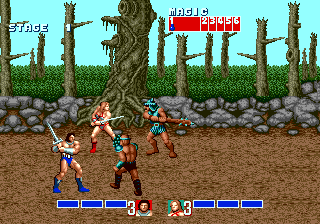
One of the most classic of beat 'em ups, Golden Axe lets you pick one of three characters, a male barbarian, female amazon, or dwarven axe-wielder, as you crush your way to the castle of Death Adder, the main villain. Characters have magic in the form of blue vials that do varying levels of destruction depending on the amount, and there are also numerous monsters you can mount and attack from. I won't lie, as an early Genesis title, there are better beat 'em ups that have aged more fairly. It is still Golden Axe, however, and it's definitely worth at least one playthrough.
Oh and those death screams are terrifying.
Golden Axe II

Definitely an improved sequel to the first one. Same characters, but cleaner gameplay and more level variety. Golden Axe II is easily the best of the three.
Still terrifying death screams.
Golden Axe III

Okay, so the third Golden Axe game is a bit different. The game never actually had a proper release in North America; it was only available on the ill-fated Sega Channel, an online game service that allowed the downloading of certain games via subscription. It received a physical cartridge release in Japan, but nothing abroad...and it's probably for a good reason. Golden Axe III is rather weak. It looks pretty good, with an overall improved graphical performance and look. However, the gameplay just sorely lacks the balance and flow of the previous games. Not only that, but by the time this game came out, others in the genre were easily surpassing it. It is nice to play something thought lost, but I don't think it's anything special.
Bottom Line for all three: First two are classics, third one not so much.
Kid Chameleon

Phoning in on the "Kool Kid" craze of the 90's, Kid Chameleon took it to a platform game, with an interesting spin. You run and jump around as the quintessential cool kid, but you also obtain different masks along the way, and each transforms the kid into different characters, like a knight, samurai, fly, and even freaking Jason Vorhees, each with their own unique attacks and abilities. I give this game huge props for its distinct assortment and variation, and a lot of people do too. My one issue with it? I'm really annoyed at its level design. It's uneven and testing, and it nearly ruins the flow of the game early on. That sucks, because there's a decent game along the way.
Bottom Line: Bit overrated, but worth a go!
Phantasy Star II

Absolutely, the SNES just annihilates in the RPG department, but the Phantasy Star games on the Genesis are nothing to shake a fist at, let me tell you. Phantasy Star was throwing emotional bombshells even as Final Fantasy was getting into its own groove. Phantasy Star II is an epic sci-fi adventure with a brilliant anime art style, brimming with great characters and environments. Combat is turn-based and relatively straight-forward, but animated well and featuring great variety. This was a big game for its time!
Bottom Line: Just a great RPG for the Genesis!
Phantasy Star III

Phantasy Star III is often looked at as the black sheep of the series. The gameplay was a downgrade from II, and the story went in a different and unusual direction that threw longtime fans in a tizzy. The story focuses on characters within three different generations, and their adventures around a world with a unique identity -- one that I'm not spoiling. The two characters you play as for the first two generations will meet other characters and join together, and you have a choice of who the player character marries, which will determine the character setup of the following generation. Combat saw an auto-attack feature, but downplayed previous elements such as special attacks ("Techniques") and wasn't graphically improved. Other RPG elements remained largely the same (turn-based, random encounters).
Bottom Line: Really not bad, but admittedly not as good as the others.
Phantasy Star IV

After III, Phantasy Star IV roared onto the stage as an antidote to the unpopular changes from the previous game. It brought back the more traditional structure Phantasy Star II, and, although not a graphical beacon at the time, brought with it many improvements both in the combat animations and overall look and feel. The story, anime style, and combat techniques were all expanded on greatly, and Phantasy Star IV became even bigger than its predecessors. This is just an incredible game.
Oh and uh, get this: when it was first released, the price of the game was about $100.
Bottom Line: Along with II, make up the defining RPG's on the Genesis.
Ristar

Another bi-product of video gaming in the 90's was the continued experimentation with different platform "mascots." There were attempts to emulate "the 'tude" via the likes of characters like Bubsy, and even the goddamn 7-Up dot. I kid you not. So along comes Ristar, a cute little star-thing that body slams his enemies into space dust! Ristar can outstretch his star-hands to either grab enemies and fly towards them / pull them closer to slam into them, or grab onto ledges and trees so he can fling himself in a desired direction. This is a charming game to be sure, as the character and environment design is really quite nice. You'll quickly be annoyed by Ristar's asinine voice, however, and the charm might have an adverse effect. The level design is good, offering a free range of heights and secret areas to maneuver around with a solid flow. Controlling Ristar's hands can be tricky though, especially in tight situations like boss battles, where you may just find yourself praying to God and flinging yourself into every which way. Honestly though, there's just not enough to distinguish Ristar from other platforms of the time, despite its relative polish.
Bottom Line: Cute and charming...but forgettable.
Shining Force

I'd wager the Shining series isn't too well known, but would you believe that it continues to this day? The series is unique in that many of its games fall into different genres from one another, and Shining Force, along with its sequel, fall under the turn-based tactical genre, as opposed to the actual first game in the series, Shining in the Darkness (also part of the game collection), which would be considered a dungeon-crawler RPG. If you've ever played a Fire Emblem game, or even Advance Wars, you can get the gist of how this game plays. You move individuals along tiles that make up a grid-like battlefield, and can position yourselves to attack enemies if you have enough movement, magic, or strength to allocate to such. Your characters have classes that level up as you fight, and you can improve the stats used in battle. Outside of the combat scenarios, you move around towns in a similar manner to RPG's like Final Fantasy, where you can talk to people and equip bought items.
Although the soundtrack is pretty great, the text scrolling and cursor sounds can kind of grind on your ears after a while. But the graphics are excellent, with bright and varied colours that make for great environments and character portraits, and even better battle animations when the two sides attack. Give this a go if you like "tactics" games!
Bottom Line: Great turn-based tactics/strategy game, with cool RPG elements!
Shining Force II

Shining Force II really is more of the same thing, as there aren't any huge improvements or anything to really distinguish it from the first one, save for the story. So I don't have much to add, but any fan of Shining Force will find more of what they like here, as long as they aren't expecting any huge leaps in improvements or changes.
Bottom Line: Slight improvements over its predecessor, but still more of a great thing.
Shining in the Darkness

As I mentioned before, Shining in the Darkness is indeed the first released game in the Shining series, and as opposed to its tactics turn-based successors, the game is a dungeon crawler with more traditional RPG elements. You control the characters via a first-person view, shifting from left to right and up to down to maneuver the towns and dungeons. You can buy items and talk to folks in town, and learn more about the setting and story, which ties in with the future titles.
It's a good all-around game! Great art style and designs, and it keeps the dungeon crawling fair and rewarding. The RPG elements in combat and levelling aren't as nuanced as you might hope at times, but it works on a simple level, and still offers variety in spells and combat, though granted it may seem limiting by today's standards.
Bottom Line: An engaging, if a little unrefined, dungeon-crawling RPG.
Shinobi III

Ninja's are awesome, man! If you're looking for a kick-ass ninja game that isn't as absurdly difficult as Ninja Gaiden, Shinobi III: Return of the Ninja Master is where it's at. The first Shinobi game was an Arcade title (included in the Collection) that was ported to the Master System (among others), and unofficially on the NES. Its sequel, The Revenge of Shinobi, was released on the Genesis/Mega Drive in 1989. The first two games are good, but the third one is just excellent! It's incredibly fast-paced and smooth, and encourages flow rather than tough jumps or obstacles, really making you feel like a swift ninja. You have your main sword attack, of course, but you also have shurikens, as well as several one-time (unless you find extra hidden ones) ninjustsu moves that can clear the screen of enemies, or make you even more powerful. You are also able to run and climb on most surfaces and walls, allowing for multiple angles of attack and movement, and to also get the jump on some poor unassuming henchmen with a flying kick to the face. There are some great fights and boss battles too, made even more epic thanks to the excellent soundtrack and graphics.
This is definitely one of the most fulfilling, enjoyable, and well-made Sega games around!
Bottom Line: HARDCORE NINJA.....it's really, really fun. One of the best!
Sonic the Hedgehog

The original Sonic game! And the one that fuelled the flames of the heated "Mario vs. Sonic" debate. This is the game that brought the notorious phrase "blast-processing" to arguments about which console was better. Sonic the Hedgehog is all about the speed! Run fast, collect rings, jump on robotic bugs, and run even faster! Advertising for this game went crazy thanks to ads using "blast-processing" to describe the speed at which the game plays.
Looking back, it is still a vibrant, colourful game with a very memorable soundtrack, and it's still pretty cool zippin' around loops and such. But that being said...I'm sorry, I hate the level design. For a game all about speed, the mid-to-late levels sure do a good job of screwing that all up! Early stages have multiple platforms ranging from high to low points on the level, so you get a little variety and exploration as you play. If you fall from the top, you can just continue on the bottom, but it never always works, especially when your just trying to lightly jump on a moving ledge, and there's some stupid set of spikes or something to ruin your day and take your rings. Later levels just keep piling on the slippery jumps and blocked platforms, and no amount of cool power-ups can save you.
Bottom Line: A classic...but I don't think it has aged as well as people think.
Sonic the Hedgehog 2

Sonic 2, however, I find far more enjoyable than the first one. The soundtrack is even better, and the level graphics and designs are much more bearable. Sure, it still has those silly jumps, and sometimes the levels can be a little too crazy, but overall I find Sonic 2 a more memorable experience. Plus, Tails is pretty cool! Even though he doesn't do a whole lot in single-player when you play as Sonic.
Bottom Line: Similar issues with the first one, but waaaay more memorable.
Sonic the Hedgehog 3 / Sonic & Knuckles

Originally, Sonic 3 and Sonic & Knuckles were meant to be released as one game, but due to time constraints, were released separately. The Sonic & Knuckles cartridge could be played as a stand-alone game, but could be attached to the Sonic 3 cartridge to get the full experience as Sonic 3 & Knuckles. Sadly, the complete version isn't available on the collection disc, but the two games are still really good. The levels in Sonic 3 look great, and they feel more expansive than the previous two games, which certainly helps with the notion of "speed" throughout the game. Playing as Knuckles in Sonic & Knuckles is a different experience, but I very much like it! Knuckles can slowly glide to the ground from a jump, and he can also latch onto and climb ledges. His style of play is much more suited to some of the zig-zagging level design in certain stages.
Pretty good games!
Also, regarding the rumours that Michael Jackson contributed to the soundtrack: this video is a great explanation of the whole ordeal.
Bottom Line: As Sonic 3 & Knuckles (together), it's freaking great, but individually? Still fun, but not complete!
Sonic 3D Blast

Have you ever wanted to run around in a clunky and bizarre three-dimensional environment as Sonic? No?
Don't play it.
Bottom Line: No.
Sonic Spinball

It is Sonic the Hedgehog's own pinball game! You toss Sonic around as a curled up hedgehog via flippers and bumpers. You collect rings and gems and points. Oh yes, points. Can't forget those points. Mhmm.
...
Bottom Line: It's Sonic pinball...(It's actually pretty decent)
Streets of Rage

Side-scrolling beat 'em ups were everywhere in arcades during the 90's, with many of them being ported over to the different home consoles, sometimes with superior versions over the other. In 1991, the first Streets of Rage game (known in Japan as Bare Knuckle: Furious Iron Fist) was developed for the Genesis, with no prior arcade release. Streets of Rage puts you in the shoes of one of three characters, each with a different move set, and places them against a ruling crime syndicate, where you gotta beat 'em up and take back the streets either solo, or with a friend.
The first Streets of Rage, sadly, isn't very polished from a gameplay and graphics perspective, especially when compared to the SNES release of Final Fight the same year. You have a jump, attack, and special button to use as you move around in the four directions during the stage. The special move is pretty neat, as it clears the screen of enemies with a freakin' rocket launcher fired from a nearby police car, but you have a limited amount of uses. The controls feel clunky and slow, especially when moving, and the enemy hit-boxes feel off, making attacking really tricky and unreliable. It's by no means unplayable, but it certainly hasn't aged particularly well.
That all being said, however, the soundtrack by Yuzo Koshiro is amazing. Its got a synth/funk/techno style that totally kicks ass, and makes the surrounding setting come to life. It would start a trend for the rest of the series.
Bottom Line: Clunky, but hella good soundtrack.
Streets of Rage 2

So what I said about the first Streets of Rage being "clunky?" All of that was massively improved upon for its sequel, Streets of Rage 2. The graphics are stronger and more detailed, and the core gameplay received a significant boost of polish and refinement. Two characters were added, Skate and Max Thunder, replacing Adam from the first game. Controls are tighter, with added variety, and the hit-spots are much cleaner. Enemy health is now visible, and the special rocket launcher from the first game has been replaced by a character-specific attack that puts the hurt on surrounding enemies at the cost of a bit of player health.
And the music is, once again, fantastic. I mentioned earlier about the Genesis/Mega Drive's lacklustre sound capabilities, but I swear you wouldn't know it from this soundtrack. Just stellar electo-funk/house trance. Oh, so good.
Streets of Rage 2 is easily my favourite of the series, and one of my favourite beat 'em up games of all time. Play this!
Bottom Line: HUGE improvement over the first one. One of my personal favourites on the Genesis. Fantastic game!
Streets of Rage 3

After the massive improvement that was Streets of Rage 2, its sequel Streets of Rage 3 kind of falls short. I think it's still pretty good, but it doesn't improve upon much besides playable characters (you can unlock a boxing Kangaroo (named Roo...)!), and the dropping of the timer in place of a "special meter." You can roll in certain directions now, which helps quite a bit, but overall combat remains largely the same, if not a little quicker.
I do like Streets of Rage 3, but it doesn't hook me like 2. The soundtrack, while still awesome, isn't quite as memorable, and the graphics and level progression aren't as impressive as before. And personally, I find the gameplay improvements make things more of a mess. Despite all that, Streets of Rage 3 is still good fun!
Bottom Line: Fun, but kind of a step back.
Super Thunder Blade

A launch title for the Genesis/Mega Drive in both North America and Japan, Super Thunder Blade (a sequel to the 1987 arcade game Thunder Blade) puts you in the cockpit of an attack helicopter that's sent along the longest road on Earth, to combat tanks, opposing helicopters, and those mean and nasty buildings that you will inadvertently crash into. You fire rockets and a machine gun bullets as you move in the four directions to dodge incoming fire, or the aforementioned silly buildings. Honestly, there's not much to this one -- it's pretty basic. Flashy explosions and a fast pace help give a surge of intensity, but you'll have to adjust to the lack of visibility. Due to the size of both enemy attacks and your helicopter, you'll find yourself constantly dashing in all directions so you can see where your being shot from, but even then you'll more than likely be caught off guard. It is good for a quick run over its four stages, but there isn't a whole lot of depth to Super Thunder Blade.
Bottom Line: Neat, and adrenaline fuelling...but there's not much to it, really.
Vectorman & Vectorman 2

Released late in the console's life cycle, both Vectorman (1995) and Vectorman 2 (1996) are action platformers that take advantage of unique pre-rendered graphics that make for some smooth and impressive animations all around. Vectorman runs and jumps, as you've come to expect from platformer games, and can shoot silver balls of energy in four directions to damage enemies or objects. You collect stars for points, and power-ups which can improve your blaster, or transform Vectorman. Each game consists of multiple stages, and they each offer a good variety in the levels, which themselves are admirably designed.
That being said, I personally find the Vectorman games to be rather bland, and not very engaging past a certain point. Many of the stages have an empty feel to them, and the soundtrack doesn't really get me into it. But, the flow of the games are pretty solid, and the animation in both is still super smooth. Despite my reservations, the game's themselves are ultimately polished and well-rounded.
Bottom Line: Cool and unique platformers, though personally, not very engaging. See what you think, they're worth a try!
That does it for the main games included in the collection! But I can't just leave it here! There are 7 unlockable arcade games, and 2 unlockable Sega Master System (Sega's system prior to the Mega Drive/Genesis) games. I've already come this far...
Note: I won't have as much to say about these games, since I've already mentioned some, and others are pretty simple.
ARCADE
Alien Syndrome

With one or two players, your objective is to rescue the hostages strewn about the levels, all while engaging and eradicating the alien threats. When you've rescued the hostages, the level boss appears, and must be defeated before moving onto the next level.
Bottom Line: Pretty fun! Works great as both a single player and co-op game.
Altered Beast

I've already mentioned Altered Beast, so nothing new to add here. I should note that, at least on the PS3 version of the collection, the sound can be a bit screwy on the bosses. Just a weird emulation glitch.
Bottom Line: Same as before!
Congo Bongo

From an isometric view point, you have to guide the safari person up the platforms, while avoiding objects and crazed animals.
It's pretty much exactly like the original Donkey Kong.
Bottom Line: Meh. Play Donkey Kong instead. Much better experience.
Fantasy Zone

As a living spaceship called Opa-Opa, you move around strange alien worlds taking out the flying enemies, and destroying the base targets. You can buy upgrades for your weapon, using money from your fallen foes. This game is weird.
Fantasy Zone was really popular in Japan on both the Master System, and in arcades. So much so, that Opa-Opa was the unofficial mascot of Sega for a time.
Bottom Line: Bizarre and cute, worth a look!
Shinobi

I mentioned this one in passing when I talked about Shinobi III. This is the original Shinobi that started the series. The gameplay is similar, but certainly not as fluent as later iterations. You must rescue the hostages throughout the stage in order to progress to the level boss, and one of the hostages will give you a special power-up. Getting hit by just one projectile or attack will net you a death, so watch out!
Bottom Line: Good, but hard to play after Shinobi III.
Space Harrier

Space Harrier is an on-rails shooter that has you flying in four directions, shooting balls of awesome energy at approaching enemies! The game may be pretty simple now, but at the time, the graphics were a huge deal. And you know what, I still dig the designs in this game!
Also random fact: this was one of a handful of games that was ported to the Sega Master System in 3D. With special glasses that you can hook into the console, you could play games like Space Harrier in that familiar, nauseating red/blue 3D.
Bottom Line: Significant, and still cool!
Zaxxon

In Zaxxon, you control a ship along an isometric trench-like level, shooting your way past walls and turrets. This is one of the granddaddy's of isometric shooters, released all the way back in 1982! Still pretty decent in its own right, 32 years after the fact!
Apparently, Zaxxon got its name from its revolutionary use of the isometric view point, also known as axonometric projection.
Bottom Line: It's old and basic, but for what it is, it's still good!
SEGA MASTER SYSTEM
Golden Axe Warrior

Despite its name, this game has very little to do with Golden Axe outside of a few characters. Unlike its arcade beat 'em up counterparts, Golden Axe Warrior is instead an adventure game from a top-down perspective. You name your hero at the beginning, and venture forth with your sword, three hearts of life, magic meter, and lust for currency in the form of horns. You move across multiple sliding screens, discovering secrets and defeating enemies...you might be able to see where I'm going with this. Golden Axe Warrior really is just a less fun Legend of Zelda. It's playable, and has its fair share of dungeons (known here as labyrinths) and items to get. But it really just makes me want to go play and enjoy LoZ on the NES.
Bottom Line: A mediocre Legend of Zelda clone.
Phantasy Star

Okay, we're closing out this enormous post with a damn good game: the original Phantasy Star. As early RPG's go, Phantasy Star is certainly one of the best and most memorable, and it was the precursor to a huge series. As the heroine Alis, you begin your epic sci-fi adventure in a city on the planet of Algol, where you must venture out and avenge the death of her brother Nero. It's a strong story, accompanied by strong gameplay, which bares a resemblance to Dragon Quest with its first-person style combat and tactics. But thankfully, with a lot less grinding.
The presentation in both graphics and sound is excellent, especially considering the game's age, and the cutscenes in particular are fantastic. It may be a bit overlooked because of its sequels, but the original Phantasy Star is definitely something special.
Bottom Line: A must play for RPG fans. Holds up really well for its time. It's quite a game!
And with that, we're done. Wow! This took me a while, haha, but I hope you learned something new about the Mega Drive/Genesis! This Ultimate Collection is absolutely worth picking up in any event. There's some fantastic games here, and for its asking price, I personally think its totally worth it.
Thanks for reading folks, cheers!