Showing posts with label review. Show all posts

Tuesday, March 17, 2015

Donlevy Reviews Hotline Miami 2: Wrong Number -- Beware the Chicken Mask


Hotline Miami was psychedelic insanity and brutality in an inexpensive and replayable package; a stellar example of simple mechanics with intense execution. It's sequel, Hotline Miami 2: Wrong Number, aims to expand on what the original created with new masks, more gameplay and an improved story that tackles even more characters and time frames.
Given the nature of the preceding game it's an ambitious undertaking, but one that, sadly, doesn't come together unscathed. An incredible new soundtrack and expanded narrative don't make up for flawed and frustrating gameplay choices that take away from what made the original so invigorating, even though there are semblances of such greatness to be found.


In Hotline Miami, the player controlled the mysterious Jacket as he went about 1980's Miami slaughtering Russian gangsters in their hideouts at the behest of bizarre phone calls. He could wear multiple masks that would each bestow a trait or bonus that changed how you approached each level. In Hotline Miami 2, the player now controls multiple characters rather than select individual masks, with events flashing between both before and after the first entry. This means the game serves as both a sequel, and as a prequel. The story is divided up into several chapters, made up of various "scenes" each with an intro and ending/results screen. Of the characters, some are allowed a choice of ability or weapon, or in the case of The Fans, four (technically five) different characters with their own traits. Other characters exhibit unique attributes never before seen. Evan, for instance, is the only character that is non-lethal, unless you continue to finish off a downed enemy. Otherwise, he disassembles guns he picks up, and doesn't kill with melee weapons. Alex & Ash of The Fans are a brother/sister duo who wield a chainsaw and gun. They're hard to control, and susceptible to a few pathing issues, but are absolutely memorable.

What makes the Hotline Miami games so immediately striking is two-fold: a combination of the pixel-based ultra-violence and the mesmerizing electronica/house soundtrack. The games evoke a colourful, exuberant 80's landscape through these features, and are stylized with an almost hedonistic flair. In fact, it's in this sense that the games bridge their theme and gameplay; from psychedelic to psychosis. Levels are drug-addled insanity, with a pumping, fast-paced song filling each level, peppered with colours, numbers and blood flying all about, and dozens of bodies in the wake. When the mayhem is done, the record stops and you're left to witness the gruesome landscape before you, as a terrible reminder of your actions.


Because make no mistake, like its predecessor, Hotline Miami 2 is bloody, brutal and utterly, utterly violent. Parents best keep their children away from this one. You take out the faceless, pixel-made enemies in morbid and horrific ways, and Hotline Miami is not above disturbing the player. Guts and gore are commonplace as you achieve your main objective: eliminate each level's opposition. From a top-down view of the level (usually a building), you control the character in any direction, being able to throw punches or use weapons with one button, throw and pick up said weapons with another, and finish a downed enemy or perform a special move with one more. You also have a "lock-on", and a "look" button, the latter of which allows you to see further ahead, and which you'll be using a lot, and the former of which you will likely not use at all, as it is often more trouble than it's worth. You usually can only withstand one hit, or a few stray bullets, so the core element of Hotline Miami is quickly and efficiently taking out every enemy before they get you. Simple, hey? Well, besides the average bat-wielding henchmen, other enemies include gun-wielding henchmen -- the bane of every player -- bigger baddies that can only be killed with said guns, and fast baddies that can only be killed by melee attacks. These folk exist to screw with you, so juggling priorities on who to take out and when is an engaging element of the typical fast-paced nature of the game.


That is of course all well and good in theory. Sadly, a few additions to the game hinder what is already a proven formula. For starters, while the decision to have multiple characters over different masks make for better story and variety overall, it's ultimately more linear because of your restrictions on playstyle. Most of the levels don't feel particularly geared towards a certain character from a gameplay perspective, and the levels where you do have a choice are limited to 3-5 masks/characters/weapons.

Which leads to the most evident problem: the levels themselves, which have been expanded both in length and level size. It's surprising, given that a few key levels are totally unique and delightful only because of their scope. Indeed, those levels evoke classic Metal Gear, except with an unreal amount of blood. Yet they too fell prey to the irony I faced: that even though the levels appear to be sufficiently wider and privy to different tactics, I felt more restricted in my approaches than I have ever been before.

As an example, there's an opening section of a mid-game level that's one large hallway with two slight indents on the north and south side. You don't start with a weapon, and only one of the guards has a gun: and he has a clear line of sight to you in every possible way unless you are essentially in the doorway of the level start. There's absolutely no cover at all. And of course, he patrols alongside a melee-immune enemy. So, you either get shot/hit trying to take out a nearby enemy holding a throw-able weapon (presumably to throw at the guy with the gun), or taken out by his buddy AND shot if you try and get the guy with the gun outright. You know, some might call that a "challenging puzzle," but I say nonsense. You are entirely limited on options, and you'll be replaying such a simple level over and over until it feels like you either cheated your way to the next section or exploited a glitch or "cheesy" solution. That's simply not fun. That's insulting.

And when I said you'd be using that "look" button a lot, I meant it. You'll be making good use out of the feature, so much so that most of the game will be spent in it, which causes problems when encountering enemies at close range where the disorientation usually leaves you dead. Levels at each point in the game practically force you to constantly and consistently use the feature to look for two things: windows, and gun-toting henchmen. Windows, as you might infer, are an immense hazard, and an immense pain. They allow enemies to spot you, AND shoot you, through the glass. Windows are not a new feature, but they've been exploited to an absurd amount, to the point where I'd call the enemy hangouts less "gang den" and more "carnival fun house." With less of the fun.


In fact, the amount of both windows and guns in this game has seemingly been increased by a tremendous amount. And you might be able to tell where I'm going with this. The larger and less timely levels make you a target from across the map by enemies with pin-point accuracy. Sometimes far enough that you'll likely not even see them until they unexpectedly run up to you. This fact, coupled with the partitioned design of the rooms, means that a great majority of your successes will be from baiting enemies to a hidey-spot and eliminating them as quickly as you can, while you sit in a corner and wait. It feels dissimilar to the first Hotline Miami, wherein many levels were quick, calculated, and deliberate rushes to the finish, and your speed and reflexes determined the outcome. Here, too much time is spent in a mock game of hide-and-seek and peek-a-boo. These common occurrences make for what is basically a "camping" simulator. Enter room, sit in corner, fire a shot, wait, kill, peek out, repeat. Don't get me wrong, this was a problem in the first game too, but not in this capacity. And the longer levels make these excursions far more tiring.

There were simply too many times where when I finished a level I wouldn't feel gratified, happy, or even victorious; I'd feel relieved. Like I had just finished a burdening test of both patience and willpower. I held no care for whatever final score I was awarded upon the complete tally of my meta time and effectiveness; a complete reversal of my thoughts from the original. Several levels just dragged on, while I continually hoped the next room would be the last. That's not right, man!

On top of all of this, there's recurring glitches and annoyances to contend with everywhere. Doors and doorways are hazard zones, mostly because it's far from uncommon to see a baddie stutter and flicker in the middle of the doorway, sometimes being immune to damage unless it's precise. These enemies can also sporadically fix themselves, and proceed to end the player in the confusion. In a rush, it's also entirely possible to cycle through empty firearms in a feverish bid to save yourself, due to the stockpile of bodies likely in front of you in such a scenario. It's a consistent pain, since you're basically at the mercy of how far apart the weapons happen to be, in which case you better watch carefully. And for one reason or another, it always seems that guns never properly fire through an archway, usually as you try and move and shoot. A strange bit of clipping. You could try the lock-feature, but in that case, I say good luck.


It's unfortunate that for a game with such strong production values, the gameplay can't do it the justice it deserves. The style and themes are endearing and fascinating, and I can not stress enough how great the soundtrack is. I suppose one of the few positives of the long levels is that you have more time to listen to the stage's music! And I do highly respect the tone and art-house feel the narrative provides (the original game listed the movie Drive as an inspiration). It's tough; there are parts of the game that feel like a truely improved sequel, and that energetic rush that defines Hotline Miami is still present in the better parts. Yet the grievances and frustration in the level design are not something so easily put aside. It's fun mayhem, but it's also heavily flawed mayhem.

YAY
  • The soundtrack is glorious. Might well be the best part of the game.
  • An expanded story that adds different characters and points in time, making for good variety. A thematically fascinating game.
  • The additional characters play differently and have unique abilities. The brother/sister duo are particularly notable.
  • Occasional exhilarating moments reminiscent of the best Hotline Miami has to offer.

NAY
  • Longer levels don't work in the game's favour: makes completing them feel more relieving, rather than satisfying or exciting.
  • A few recurring glitches and design flaws make luck a far more common crutch than it really should be.
  • Too many levels just become a glorified (and violent) game of "peek-a-boo." Kills the hectic pace the series is known for.


Wednesday, December 24, 2014

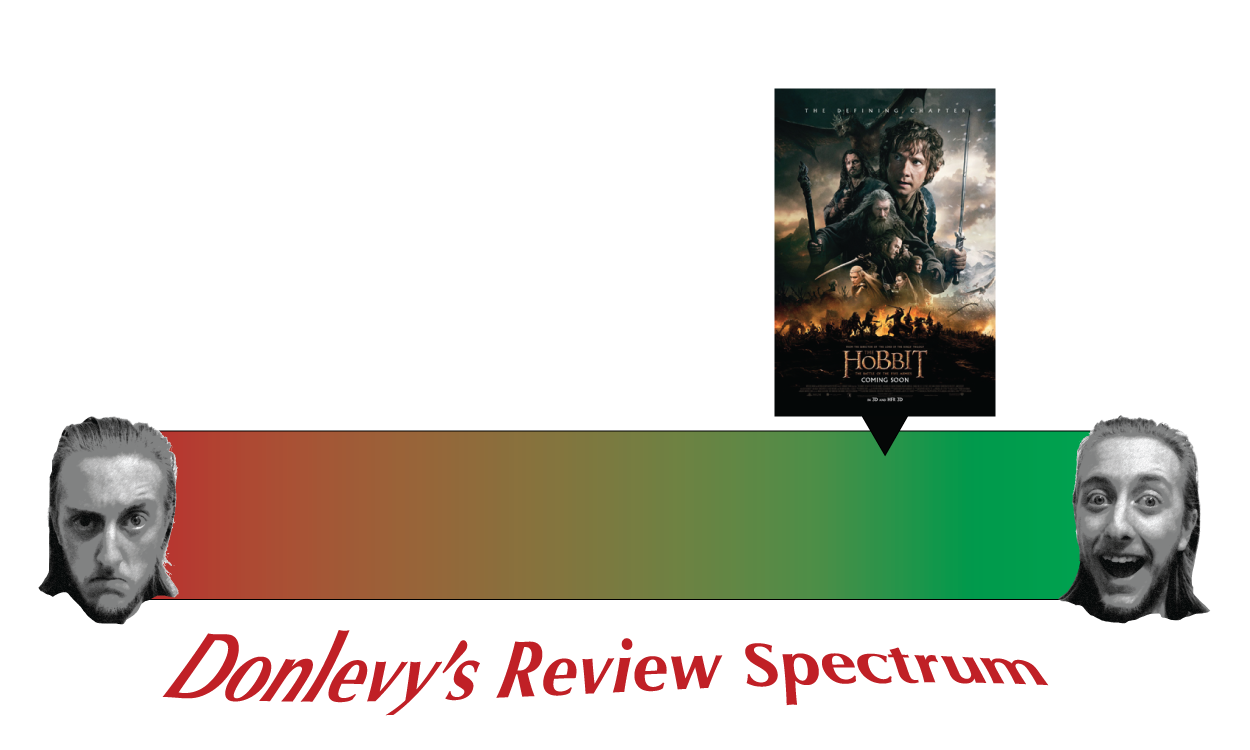
Donlevy Reviews The Hobbit: The Battle of the Five Armies


We come to it at last -- the end of an era. The Middle-Earth saga is (essentially) complete with the third and final entry in the trilogy of The Hobbit films, The Hobbit: The Battle of the Five Armies. It has certainly been a long road to get here, not the least of which has been making three movies out of a single book. I've had a mostly positive outlook on such a choice, as I feel the reasoning was sound in fleshing out additional characters and stories, but even I knew after the announcement of a third movie and the eventual name change what to expect. The Battle of the Five Armies is exactly what it sounds like: a giant effin battle. It's maybe a testament to how padded out the movies have become to make an entire film out of the last few chapters of the book, but while Five Armies certainly feels like the most stretched of the trilogy, I found it to be no less satisfying. Indeed, the battle that is the film's namesake is one hell of a battle, and despite a lingering overall feel, Battle of the Five Armies does just enough right to send off the movies in a proper and dramatic fashion, even if it doesn't reach the heights of something like Return of the King.

The film picks up immediately after the events of Desolation of Smaug, with said fiery-breathing-Cumberbatch-voiced dragon descending upon Lake-Town to exact vengeance. Battle of the Five Armies literally wastes no time getting straight to the action, and it's quite a move to resolve the aftermath of Desolation in a very dramatic and exciting way before the opening title even shows up. With Erebor vacated, Thorin and his company take control of the city and its riches. Both the people of Lake-Town and the elves of Mirkwood stake claims on parts of the great treasure, but Thorin is overcome with a sickness of the mind from the treasure hoards, and becomes paranoid, obsessed, and near-mad. Strife looms overhead as the nearby city of Dale is occupied by the men and elves, who prepare for confrontation unaware of the threat of the orcs led by Thorin's nemesis Azog closing in.

Gandalf's side of the story in Dol Gulder from Desolation is also concluded right away, where the White Council comes to his aide in one stellar and crowd-pleasing scene. I mean, Saruman O.P. Oh and Galadriel don't take anybody's crap. And Elrond is just a badass. Really, it's quite a fun scene! Although I have to be honest, I'm not sure how I feel about that entire story arc. Yes, it's a nice way to connect to Lord of the Rings by showing Sauron returning, but at the expense of basically sidelining Gandalf until he can reunite with Bilbo and the dwarves. I...understand why it's the case, even though it is primarily fan service.


And speaking of fan service, goddammit Legolas! Alright, I think it's fairly safe to assume that Legolas is included primarily as another popular connecting character to Lord of the Rings that isn't Gandalf or the White Council. You know something though? I'm, personally, fine with that. I am perfectly and totally fine with that. Legolas is and always has been an audience favourite, and at the very least, it makes logical sense given he's the son of Thranduil. A minor thing I love too (SPOILER ALERT), he provides an awesome way for Thorin to get Orcrist back after being captured by the elves in Desolation. It makes for an excellent, little scene near the end of the film (END SPOILERS). Legolas also serves as a sort of proxy between Thranduil and Tauriel, and with Tauriel being a character entirely unique to the film trilogy, I was eager to see how her side of the events would unfold. Tauriel's confrontations with Thranduil prove quite interesting, and serve as a notable contrast between her eagerness to help and Thranduil's reluctance to sacrifice the lives of his kin.


As is the namesake of the film, yes, there is a battle. A large battle of which involves fewer than six and more than four armies. The action involving and surrounding the battle itself is, indeed, quite excellent. There's lots of sweeping landscape shots and up-close scenes of the armies doing battle both on the fields and in the city. I must say what a joy it is to finally see a Dwarf army do battle, as apart from the beginning of Unexpected Journey, not even Lord of the Rings featured the race in such a large number. Finally seeing them contrast (and throw insults at) the elves is a definite highlight, especially given what comes right after!

This does, however, function highly into my disdain of the overuse of CG. Particularly in Dale, there's an awkward combination of CGI and characters that interact in oft-putting ways. It makes some scenes in Dale and elsewhere simply feel too artificial. It's an issue I've had with the entire trilogy, really. CGI just doesn't do some scenes the justice they deserve. But otherwise, it all generally works. It likely won't age well, but for now it's a petty grievance, and hardly destroys the film.

Despite the CGI issues, the one-on-one fights between characters are still pretty great, and Thorin's in particular is resoundingly satisfying (yes, even with the silliness of that scene. You know the one.). I found Thorin's arc, extending from the two previous films, to be fairly gradual, and quite well done! What a wonderful comparison it is to make between Thorin and his treasure, and Bilbo or Frodo with the One Ring. It's fascinating and interesting watching Richard Armitage give Thorin such a menacing feel, and makes for engaging scenes with Thorin and either the elves, or his company. And it's certainly enjoyable watching Thorin try to fight his own sanity, and the aftermath.


There is no doubt in my mind however that Battle still feels like the most padded of the three movies. It's obvious having three movies of one book feels awkward already, but the trade-off of having added material is, well...having added material. For instance, there's a great deal of talk about the forces of Angmar to the North that Thranduil, Legolas, and Gandalf make mention of. Okay, great, I love that their talking about Angmar! It's a substantial series of events to allude to. But...this is the last of the three movies! Why must you bring it up only to have such a plot subside nearly immediately, only made mention of once more during the final scene with Legolas?

I don't agree though that other additions have the same problem. I genuinely found that other additions to the movies over the books, such as the confrontation between Thorin and Azog, paid off in a surprising and profound manner. It's more in the context of character interaction, and expanding roles rather than sidelining them. Thranduil and Bard are good examples, where the situation in Dale prior to the battle is a part of the book, but is given far more visual cues and context in the film. And having Gandalf and Bilbo there too is a plus.


By the end, Battle of the Five Armies delivers on a satisfying and emotional level, that much can be said. No, it doesn't reach that epic feel of Lord of the Rings, and Battle certainly feels like the most stretched out, with silly moments and an over-abundance of CGI and fan-service souring the experience. And yet, the film resolved everything between narrative and action in a gratifying and substantial way; a way unique to the film trilogy. It may be a sort of give-and-take scenario here, where for every enjoyable scene there's a scene of fluff and fan-service to go along with it. However, Battle has the added benefit of being the concluding entry in a trilogy, and as such has far more weight to every scene. So, I feel it's a classic case of the good outweighing the bad. Far from perfect, and yet, surprisingly successful in concluding a trilogy, and providing closure and a full-circle to the Middle-Earth saga.


YAY
  • You certainly get a battle; exemplary and gratifying action. Gets right to it!
  • Most additions made to the movie from the book pay off surprisingly well.
  • Narrative is wrapped up with emotion and satisfaction. As good a conclusion as could be hoped!
  • A final, excellent score from Howard Shore (and excellent credits song by Billy Boyd!).
  • Enjoyable crowd-pleasing moments that make for fun times! However...

NAY
  • ...some of those moments feel arbitrary and silly. There's an over-reliance on fan-service. 
  • Some scenes use far too much CG, and make for awkward interactions with characters.
  • The most visibly stretched and padded of the trilogy.


Saturday, November 15, 2014

Donlevy Reviews Interstellar: I Don't Have a Stellar Pun

Quick note first:

Today, November 15, 2014, makes it one year to the day that I've been doing this whole review/blog thing! Way back when I was doing this on Tumblr, mind. So yeah, to anyone who's been reading what I say for the past year, thank you so much! And if you happen to enjoy it (and I hope you do) hey, even better! I'm glad I could and still can be informative and/or entertaining, and I continue to hope that you all find as much enjoyment out of my writing as I have doing the actual writing! And finally, thank you to everyone who has been so supportive of both me and the Emporium this past year! It means a lot, and it's because of you awesome folk that (on top of keeping me sane this past year) I'm always looking at more things to do in the future, including a possibly-maybe-hopefully new video (or series.... ;) ). So thanks again guys! Here's to another year (or more)!

- Donlevy


Now then...


Interstellar is director Christopher Nolan's latest original film after Dark Knight Returns, and it's damn massive in scope. Faced with a dying Earth, Interstellar follows Matthew McConaughey's Cooper as he and several NASA scientists race to the stars to find a habitable planet for the purpose of population. From black holes to wormholes, it's the final frontier for Nolan and his desperate astronauts. And for Cooper, it's a race against time to save both his family and humanity at large...as every action undertaken costs the team precious years, or possibly decades. Interstellar is no doubt a marvel of visual and audio design, but it's unfortunate that the ambitious and larger-than-life story ends up weighing it down from being something truly great. Despite strong acting and a tantalizing story hook, the film can't escape its own gravity being continually bogged down by meandering exposition and an uneven and lacking final act.

I won't use more gravity puns, I promise.

In the near-future, resources on Earth have all but depleted, leading humanity to re-prioritize their production efforts in a desperate bid to stem their eventual fate. After Cooper and his daughter Murph (Mackenzie Foy) stumble upon a facility run by the remnants of NASA and led by Professor Brand (Michael Caine), Cooper learns that Brand has an even better idea: get the hell outta dodge. Or in other words, look to the stars, and leave the Earth. Realizing that Earth is on its last legs, Cooper, a former test pilot and engineer, agrees to accompany a group of scientists, including Professor Brand's daughter, Amelia (Anne Hathaway), on a space voyage to another galaxy, courtesy of a mysterious wormhole appearing near Saturn. The caveat however is that the wormhole leads to a system in proximity to a black hole, and the gravitational force exerted makes time dilate on the extreme. The team must investigate the planets for signs of hospitality, but they must choose wisely, for each minute or hour spent is years away on Earth. And for Cooper, those are years he won't be seeing his daughter.


I find that to be quite a strong premise overall, and it certainly makes for a dramatic choice faced by the scientists in the early-to-mid parts of the film. Great acting all around too, especially McConaughey who, jeeze, is on a freaking roll lately. I give big props to the voices of the AI robots that travel with the crew, especially, and also the surprise actors/actresses that appear later on. All of the actors face the drama up front, and the crew in particular convey equal parts awe and desperation. For added effect, the crew continually receive video messages sent from family back on Earth, as the years begin to tick away back home. They make for some really special and intimate moments, and allow the story to progress back on Earth years into the future without feeling jarring. Interstellar is quite deliberate in its pace early on, also evident by how little the film needlessly lingers back on Earth before Cooper leaves (which is to say, it doesn't).
As you approach the end of the movie however, you might find that the film can be...mmm...a bit of full of itself. What I mean is that, and without spoiling, the exposition and progression the film quite successfully managed in the beginning and middle acts is squandered by constant repetition of said exposition and delayed resolution in the guise of a forced and artificial tension. Basically...dialogue and circumstance between characters do little for story advancement and more for wasting of time. It's frustrating, and it makes what would otherwise be important story moments more of a relief than anything when they occurred.

I will say though that throughout most of the film, the science behind everything is handled and explained fairly well without what I'd consider to be oversimplifying. I suppose one could argue that Interstellar asks a lot of the viewer in order to follow along, but come on man, space is cool. Sure, I'm in no way an expert in any field of science of the cosmos, but damn, at the very least it looked freaking cool.


Indeed, Interstellar has some hugely impressive visual effects and composition. It's immediately clear that the film was expertly shot, and the use of both VFX and miniatures is excellent. The various planets feel fantastically alien, yet with a hint of familiarity, unintentionally or not, that make for fascinating and interesting locales. The cinematography flows more with the mechanics of the spacecraft, rather than with the astronauts, (in contrast to say, Gravity) and situates to make gorgeous vista views and horizons. A select few scenes even make fantastic use of rotation to make for some memorable and excitingly tense moments. Careful with this film if you have a tendency to get motion sickness.

And of course, of course, the music. It's always the damn music. Well it's damn good music! Haha! And who else should be behind it than Hans Zimmer. It goes without saying, but without the music that Zimmer provides, Interstellar would have been a very different movie. There's an enormous and empowering presence of organs in the soundtrack for the tense scenes, and a softer more melancholy approach to the sombre moments. His music sets the tone of the entire film, and it's what makes otherwise more subtle scenes stand out as epic and moving. I understand that some might have wanted a more underscored arrangement for those subtle scenes, for various reasons, but you can't argue with the results. My one criticism might be that by the end, the sheer amount of all those organs goes a little overboard.

To touch on it briefly, there are most definitely more than a few nods to science fiction works of the past, likely most notably of all 2001: A Space Odyssey. One scene in particular, that I wish I could spoil but I can't, is an extreme version of a particular scene in Odyssey involving a ship and station. And it's an amazing scene here. One of the several awesome set piece moments found in Interstellar.

So yes, for all it does on a technical level, those plot issues really do keep Interstellar from achieving true greatness, falling short of the heights of the films it pays homage to. Even so, it's a pretty good movie on a visual and audio level alone, and I feel that that makes it very watchable, even if its near three hour runtime is a bit daunting. If nothing else, Interstellar is certainly ambitious.


YAY
  • Visually stunning. Space is cool, y'all.
  • Great acting all around. McConaughey has been on fire recently. Also shout out to the voices of the AI's!
  • Crazy music by, of course, Hans Zimmer.
  • More than a few nods to past Sci-Fi movies, such as 2001: A Space Odyssey.
  • Story deals with pretty hefty physics, and articulates it well without "dumbing down" too much.
  • The set piece moments are sweeeeeeeeet.

NAY
  • Artificial tension, particularly in the final act, is rather silly.
  • Plot teeters on "going off the deep end." 
  • Story gets bogged down almost needlessly by repeated exposition. 
  • Similarly, the film could have used better time management (how ironic), by which I mean, spend less time drawing out said tension, and more time resolving. Again, mostly in the final act. 


Monday, February 24, 2014

Donlevy Reviews Escape Plan!


It's the latest team up of old-school action stars, and here we have one partnership that's been a long time coming! The Terminator and the Italian Stallion together at last, that is, when they're not being Expendable. Arnold Schwarzenegger and Sylvester Stallone star together in Escape Plan, with Stallone as Ray Breslin, a security professional who specializes in testing prisons first hand -- by breaking out of them himself. Taking a CIA job offer that puts him in a prototype, state-of-the-art maximum security prison, Breslin soon realizes that the job is a ruse, and someone wants him there permanently. Befriended by fellow inmate Emil Rottmayer (Schwarzenegger), the two take it upon themselves to break free from their unknown prison, by any means necessary. Escape Plan is something of a novelty, and while it's concept and actors are up to the task, Escape Plan feels more a mediocre afterthought than a proper team-up.


Escape Plan actually starts out promising enough. The opening scene with Breslin in the prison is exciting, and cool to see how it plays out in an un-lengthy manner. There's obviously some suspension of disbelief involved; a few methods are incredibly outlandish, but it's interesting and neat nonetheless. This feeling carries throughout the movie, and it does add to certain suspenseful and timely scenes. When Breslin lands in the maximum security prison after the opening, the pace continues well, with the film allowing some nuance as Breslin analyzes and struggles with what is supposedly the perfect prison. It's here he meets Rottmayer, and where we get to see Schwarzenegger and Stallone converse and plan. Stallone is...well he's Stallone, so if you're familiar with his movies, you know what to expect from him. The same goes for Schwarzenegger. I did, however, find that both of them had a decidedly more subtle and underscored performance, which was cool at first...but I found it didn't really change as the movie went on, and the novelty of seeing both Stallone and Schwarzenegger together began to wore off. There's a lack of notable dialogue between them, and while both have some good scenes on their own, together it's lacking. The one fight scene between them showed promise, but barely lasted a short time. Besides those two, the other characters are split between inside and outside the prison. Breslin's team consists of Abigail Ross and Hush, Amy Ryan and Curtis "50 Cent" Jackson respectively, trying to find his whereabouts, with the Warden, his right-hand man, and Dr. Kyrie working in the prison. The performances on both ends range from good to average, with the action and sub-plot involving Breslin's team feeling rather tacked-on, only offering a not-really-needed breather from events in the prison. The Warden, Willard Hobbes (played by Jim Caviezel), is sly, brooding, and ruthless, and Caviezel's performance is admirable at first, but ends up feeling mediocre and unsubstantial. Sam Neill of Jurassic Park fame plays Dr. Kyrie, a kind of strange role that has him tired of the daily prisoner interaction, and sympathetic to Breslin's plea. Unfortunately, his character is not very well developed, and his story isn't resolved in the slightest. Kind of a funny side note: there's a scene where Breslin and Rottmayer are surveying and analyzing a few armoured guards around their area, and they give them descriptive names like "chicken-man" and the like. These faceless guards are given just about as much characterization as some of the supporting characters.


The context for what goes on during the middle of the movie inside the prison makes sense, and includes the previously mentioned rather good individual scenes with Breslin and Rottmayer, but there's a lot of unnecessary info passed around other characters that either doesn't amount to anything in the prison, or is used too sparsely outside involving Breslin's team. The build-up, or rather, escape plan, does have it's cool moments though, despite being a little too long overall. Tension and close-calls help make these parts more exciting, and the lengths at which the pair will go to in order to get the slightest bits of info is equally notable. The film's climax is pretty decent too, all thing considered. There's a pretty big "HELL YEAH" moment involving Schwarzenegger, and a very 80's-esque explosive finale, but, sadly little more than that. Even so, the ending wraps up nicely, and doesn't linger longer than it should.


But by the end, Escape Plan feels like something of a missed opportunity. It's a pretty harmless movie, and it has elements of that 80's style that Stallone and Schwarzenegger are known for, but there's a lack of anything that truly stands out. It's a good concept, and there's some cool and tense scenes, but Escape Plan feels lacking in many respects. So while it is indeed neat to see Stallone and Schwarzenegger together, I think I'd stick to The Expendables.


YAY
  • Respectable performances from Stallone and Schwarzenegger, with some really good individual scenes.
  • Cool concept that stays relevant and somewhat interesting.
  • Actually decently paced early on.
  • No particularly bad acting from the supporting cast.
  • Cool seeing Stallone and Schwarzenegger together, but...

NAY
  • ...the novelty eventually wears off.
  • Lack of stand-out action. 
  • Suffers from predictable twists.
  • Drawn-out, with some entirely unnecessary moments. 
  • A lot of missed potential.


Monday, February 17, 2014

Donlevy Reviews The Lego Movie!


Everything is awesoooome....

Wow. 

If you think of something called The Lego Movie, the first thought would probably be anything but what it actually is. What could have easily been a cashed-in, generation pandering, monetized-centred mess of wasted talent turned out to be the exact opposite, and likely one of the best movies of the year. Easily one of the most memorable, quotable, and all around enjoyable films in recent memory, The Lego Movie is a stunning achievement in nearly every field, and one that both younger and older generations can experience together.


Emmet Brickowski (Chris Pratt) is a simple Lego construction worker, and one who is so non-outstanding that all others fail to find anything noteworthy about him. Always following the instructions to the number, Emmet lacks free-thinking in his simple life. This all changes with a chance encounter with the fiery Wyldstyle (Elizabeth Banks), where Emmet encounters the mystical Piece of Resistance, and is then thought by Wyldstyle and Vitruvius (Morgan Freeman) to be the prophesied "Special," who will save the world from Lord Business (Will Ferrell) and his superweapon, the "Kragle." Emmet's simple life is turned upside down as he encounters the other "Master Builders," including Wyldstyle's boyfriend Batman (Will Arnett), the pirate Metal Beard (Nick Offerman), and the "1980's-something spaceman," Benny (Charlie Day).

The plot is really cool, and it's all extremely well paced. The film doesn't hold back in showing off many different and unique locations, and it's always exciting to see cameos from characters and sets that you may not have been expecting. It adds to the excitement and anticipation of what's to come, and keeps you invested for the entire duration of the film. The voice acting is top-notch, with a stellar cast of some of the finest actors around. Everyone I mentioned before is charming, witty, and funny, and I might add that Will Arnett plays the best Batman I've heard in a long time. And to top it off, there's Liam Neeson as Bad Cop/Good Cop, who is after Emmet and the Builders. It helps in no small feat that the writing is both smart and funny, able to appeal to a wide audience both young and old. Nothing feels awkward or out of place, and along with the previously mentioned voice actors, it all just works seamlessly and flawlessly.


From the beginning, there are numerous hints and nods to the larger scope of the narrative, from the self-referential humour to the direct acknowledgement of other "sets." In a way, it has a meta feel, but it's one that I think everyone, regardless of age, can enjoy based on experience. There's a particular twist later in the film that drives everything home, and all the build-up and references, pardon the pun, fall into place. The best part of it though is just how well it works. It's as if with one swift move, the movie becomes immediately more than the sum of it's parts (again, pardon the pun). I'm obviously not spoiling it, but it really does just elevate the movie on a whole new level. It becomes something more significant in a subtle and non-pretentious way, and it has a lasting and immeasurable appeal that spans the generations of everyone watching the movie. It sounds silly and far-out, but in the context of the film, it somehow totally fits.

Visually, the movie is entirely comprised of LEGO pieces. And when I say entirely, I mean everything from the clouds to the fire effects. It's a visually amazing film, and in terms of animation alone, it's one of the best. Construction, and especially destruction, of various pieces, buildings, or sets is filled with intricate pieces everywhere, and there is one scene in particular that rivals the most dramatic Lego destruction you may have ever thought of. The designs of everything from Batman's Bat-Vehicles to Lord Business's tower are neat and worthy of set's unto themselves (which I imagine are a reality anyway). And a lot of the times when pieces are moving around, there's this funny and cute little whooshing or "child-like" sound that accompanies it. And uh, speaking of sound, The Lego Movie is also not without a delightful soundtrack of it's own, along with one ever-catchy song you'll have to see the movie to hear in a proper form. It's...um...well it's sort of...awesome...


Which pretty much sums up the movie in general, everything is awesome! I really didn't expect this kind of passion and nuance in a Lego movie, and yet, here I sit proven delightfully wrong. It is a fabulous film, well and truly. It's got something for everyone, no matter the age, and the movie doesn't shy away from bringing a strong charm and humour that nails all the notes, and then some. Rounded off by a fantastic voice cast and extremely well done animation and visuals, The Lego Movie is something Special. An undoubtedly memorable film that is sure to be one of the best of the year, The Lego Movie is not to be missed.

SPACESHIP!


YAY
  • Appealing to literally everybody, young and old.
  • Infinitely charming and funny.
  • Fantastically, uh, fantastic voice acting!
  • Visually amazing. Everything is LEGO and it's awesome! Everything is awesome...
  • Superb twist later on that makes an already great movie an incredible movie.
  • SPACESHIP!

NAY
  • No real issue with the film in which I can put something into the "NAY" part of this review. Seriously, any faults are few and far between.


SPACESHIP!


Friday, February 14, 2014

Donlevy Reviews RoboCop (1987)!


Alright, time for some RoboCop! The remake/reboot of the 1987 original, simply named RoboCop, was released only a couple days ago. But screw that, I'm talking about the OG RoboCop from 1987! Ha, if people still say "OG." Anyway, as action movies from the 80's go, RoboCop is pretty notable, and memorable, for the time. Sure you had The Terminator, and Rambo, but you know what was missing? A cyborg cop! Yeah, the merchandising for this movie must have been a field day. RoboCop had enough weight to follow up with two sequels, both of which I hear are nowhere near as good as the original, but we don't care about those movies today. No, what you're here to know is if the original is worth watching. And you know what? It definitely is. As action movies go, RoboCop is damn good. It's got some crazy violence and action, great effects, and one badass cop. It's aged better than I though it would have, and while it still suffers from an overly-ambitious plot, RoboCop is definitely a noteworthy action flick.

In a near-futuristic Detroit (2014, as a matter of fact), crime and corruption has eroded much of the city, where everyone from the police to the government is at the mercy of corporate giant OCP (Omni Consumer Products). Alex Murphy (Peter Weller) is reassigned to a local precinct with officer Anne Lewis (Nancy Allen) as police officers contemplate a strike, and on a routine patrol, chases after known crime boss Clarence Boddicker (Kurtwood Smith, ie. Red from That 70's Show!). Murphy is shot down and effectively left for dead, but OCP uses his body as the basis for their new RoboCop program, and they transform Murphy into...well, RoboCop. Did you expect something else? RoboCop then proceeds to be a badass and takes on the scum of Detroit, all the while OCP watches over him. Watch the movie to know the rest!

To get the main criticism with the movie over with first, the background plot is pretty underdeveloped, and a lot of supplementary material is kind of left hanging, or unaddressed. There's a lot of background events happening over the course of the film, like the aforementioned police strike, as well as a brewing war overseas. They're nice touches that add to the setting, but have little to no impact on any events in particular. A lot of this is told through simulated TV news briefings, with an 80's flair, and while the stories follow a beginning and end over the course of the movie they offer no real payoff, and ultimately, they become rather unnecessary. The whole thing with OCP and their limitless reach is a neat concept, and I like how it's already a given, but it feels a little too convenient at times, although to the film's credit, much of it IS actually addressed. 


But the rest of the movie knows what it's all about: the flow of the film is top-notch, with an immediate and adequate display of awesome from RoboCop as soon as he's complete. His introduction is short, but neither slow nor hasty, and he quickly gets into the groove. One-liners abound as RoboCop dispenses his robotic justice to the felons of Detroit, and so efficiently that his effectiveness is readily apparent. Later in the film, and without spoiling much, RoboCop removes his helmet, and it goes a long way to show how good Weller is in the role. There's a strange subtlety in his movements, and it's really cool as he begins to show a little more humanity each minute. But damn, if there's one character to watch, it's freaking Smith's character Boddicker. Slimy, sly, and cold, the performance is just so good. The use of the character is such that he continually amounts a stronger offensive force against RoboCop at each meeting, and the final shootout against Boddicker and the rest of his gang of memorable thugs is very, very cool. 

The one prominent effect in RoboCop, besides the plethora of blood and explosions, and one really far-out toxic waste effect (all of which are really cool) is the stop-animation used for the ED-209's. They're menacing and powerful, and it really shows in the face-off between ED and RoboCop at the top of the OCP building. The effect is really cool and natural, and not afraid to add a slight gag every now and then (one in particular reminiscent of Star Wars). On that, there are just a couple of bits of humour thrown in to offset the otherwise dystopian setting. Characters or one-liners, or even really weird and sexist commercials, add a bit of "light-heartedness," that surprisingly doesn't feel out of place. I mean, jeeze, when you think about it, the whole movie is about a mechanical cop giving off a few catchphrases every now and then. How serious can you really be?

The action is great, the pace is smooth, the effects are slick, and the performances are of the top quality. RoboCop is most definitely a fine film indeed. Sure, some of the plot is up in the air, or sometimes meaningless, but the rest of the movie's action and enjoyability make up for it. Go watch this movie. Yeah, watch it! Don't go see the remake. Watch the original. It's a damn good time!


Tuesday, February 11, 2014

Donlevy Reviews Ico & Shadow of the Colossus!

Welcome welcome, fellow people! If you're coming from Tumblr, or anywhere else, be sure to check out my introduction earlier in the blog! And as always, thanks for checking this all out! I hope you enjoy the premiere review on this blog! 


As I teased through Tumblr, I do in fact have a double helping of game reviews for you today! Consider it payment for my missing of the previous content days. The two games in question are Ico and Shadow of the Colossus, both of which can be found remastered on one wonderful disc for the PS3, as shown above (which also features the FAR superior European/Japanese Ico boxart. The North American one is just terrible.). The games were originally released on the PS2 in 2001 and 2005, respectively, and both share many similarities, as well as Shadow of the Colossus being a spiritual prequel of sorts to Ico. Both games make wonderful use of simplicity and minimalist design to showcase the world and respective game mechanics, as well as allow the player to piece together and elaborate upon the stories at their own behest. These are wonderful games, and are a testament to the power of the PS2, as well as the magnitude for interactive storytelling. Absolutely two of the most defining puzzle games in video game art, and each hold up remarkably well in the new and awesome HD collection for the PS3. But I know you...oh yes, you want details, do you not? Very well then.
Quick note: I'm only using one Donlevy Spectrum (trademark still pending), and that will be for both games together, since their overall positives and negatives are largely similar. Newcomers: yes indeed, I use a Spectrum for reviewing!

Ico

Ico involves very little backstory: you play as the young boy Ico, after he is lead into a prison-like castle by members of his village, for the sole reason of possessing horns upon his head. As you begin to explore after breaking free, you come across a mysterious young girl named Yorda, whom Ico is unable to understand when she tries to speak. Regardless, you control Ico as you quite literally guide Yorda through the castle, attempting to find a means for the both of you to escape the vast castle grounds. Along the way however, eerie shadow-like figures emerge to try and recapture Yorda, and you must defend her with Ico's weapon, either a plank of wood or, eventually, a sword. Failure to do so results in a Game Over, and a transport back to one of your last saves, which take the form of strange stone benches found in various locations throughout the castle. To help Yorda move and advance through the castle, your duty is to solve the various puzzles that make up the areas, usually involving climbing and jumping, or the moving of certain objects.


Ico offers practically no "hand-holding" to the player (rather ironic given that that's the main mechanic of the game) and despite a sometimes linear path, leaves it up to you to explore the castle and discover what to do. This is largely one of the best aspects of the game, in that it makes success all the more satisfying when you complete a task. However, it can lead to unruly frustration at times, and particularly at the beginning, it can drain the desire out of any new player. See, with a game like Ico where so little is directly revealed to you, both in story and in gameplay, it can feel like there is lack of incentive at the beginning to continue past the immediately tricky or obtuse puzzles. In this, it does require a lot of the player, and it makes Ico somewhat demanding, but it absolutely is worth seeing to the end, despite the reticent structure. Lack of direction or directive can eat up your time playing this game, and while it's admirable, it can be a real pain when the solution or path is hindered by either the camera or misdirection. Indeed, there are more than a few environmental "red herrings" of sorts that can throw you off your course. Boxes that can be moved, and some that can't. A long corridor that leads to nowhere in particular. It's all part of the fun of exploring, but Ico is not impervious to annoyance. And it doesn't help that the controls and camera are far from perfect. The controls are very sensitive, with Ico sometimes jittering and falling over an edge with no intent, or jumping off a (very high) ledge by mistake. And with the camera, the placement and tricky depth of field can mask your task, or just make a jump a little too difficult. Still, the rest of the puzzles are very well designed, and never require too much from the player, as you have an intentionally limited number of actions to take at any given time, and you'll understand what you need to do. If progress is ever hindered, you will get through it eventually.


And as you solve the puzzles and progress through the castle, you'll begin to form a unique story of it all, almost entirely implicitly. The castle and the land is mysterious and haunting, with an isolated yet disturbed feeling that echoes throughout the chambers and courtyards. Ico specializes in a minimalist philosophy for it's setting, and everything from the fog from beneath or the broken statues and benches contributes to a really unique and fascinating atmosphere. As a game from 2001, the game still holds up well graphically, and the HD update goes a long way to pushing the lighting and emphasizing colour. There isn't a lot of music to speak of, apart from the AWESOME credits song, as much of the sound design comes in the form of ambience and sound effects, but it goes a long way towards the setting and tone.

So apart from some frustrating controls and camera, and some annoying misdirection, Ico is a special game with a wonderfully unique narrative and setting, and some intensely satisfying moments that last even past the end. It was something of a hidden gem during the PS2 days, but now with this HD Collection, Ico truly gets to shine as an early and stellar example of art direction within a game. Very cool indeed.


Shadow of the Colossus

Similar to Ico, the backstory to Shadow of the Colossus is short and simple, but a bit more elaborate. You play as Wander, a young man who has fled his village with his horse Agro, and the body of his beloved, Mono, after she was sacrificed in a village ritual. Wander ventures to a mysterious and forbidden land far beyond his home in a bid to resurrect Mono with the help of the deity Dormin, no matter the cost. To do so requires the death of sixteen Colossi that inhabit the vast land, and with Agro, Wander sets out to find and eliminate the various Colossi.


Embarking from a central shrine, the entire landscape opens up for Wander and Agro to travel to. The area is vast in both scale and scope, and while much of this game will indeed be spent travelling around, it is never dull. The areas are varied and serene, but yet very isolated, and it adds to a haunting and scenic journey wherever you go. Crossing a narrow path alongside a mountain only to peek down at the enormous lake below is a marvellous sight, and it is at times like these where the game feels majestic and wondrous, and a bond is formed with Agro, your only companion along the way. Controlling Agro across the land is very tricky at first, as you have to adjust to different speeds for different occasions, and it can be frustrating to control Agro by an edge, but eventually the controls will be learned enough to perform a few useful tricks as you gallop across the land. There are different, but subtle, secrets to uncover as you go around, such as different save shrines, or collecting food and shining lizard tails that improve your health and Grip gauge (which will be mentioned shortly). These secrets are easy to miss, but along with a time trial mode and several other unlockables, these add to the gameplay and replayability by a good margin.


You have at your disposal a bow with unlimited arrows, as well as an invaluable sword which directs you to the next Colossus via the reflecting of sunlight. Before leaving the shrine to find them, Dormin will leave you with a hint and slight description (in the form of an idol) about the next Colossus to defeat, and the cryptic and cool nature leaves you guessing in anticipation. Reaching each respective Colossus can range from simply finding the closest path, or past a series of complex platforms and jumps (a la Ico). Finding the correct path can sometimes be a hassle, as the sunlight sometimes directs you to an area in which a path is not immediately observable. Finding the Colossi is a puzzle unto itself, and I certainly found it enjoyable thanks to the aforementioned fun of travel, even if it was sometimes quite befuddling. But the bulk of this games awesome nature comes in the form of taking on each respective, and quite varied, Colossi. Each Colossus require a different strategy to take down, each themselves a puzzle, but the one common element found throughout the massive battles is climbing. I mean, you'd be pretty useless if the only thing you could do in the game was shoot petty arrows at these behemoths. As I mentioned before, you have a Grip gauge, or rather a Stamina gauge, and you are at it's mercy as you climb a Colossus in search of their weak points, where you must then use your sword to bring them down. Holding on to fur or ledges slowly decreases the gauge, as does minor things like firing the bow and swimming (yes, there is a terrifying water-based Colossus), and if your gauge runs out, well: *pheuuuuuuuuuuuuuuuuuuuuuuuuuuuuuuuuuuuuuuuuuuuuuu splat*. Climbing and figuring out how to take down each respective Colossi is fantastic fun, and every single fight feels like a tremendous boss battle on an epic scale, and solving the puzzle of the Colossus and taking them down is a wonderfully satisfying feeling. These are truly memorable fights, and each of the Colossi exhibits different habits and dispositions; some are indifferent to Wander, while others are fiercely aggressive, and it makes the Colossi feel more unique and mysterious than simple enemies.


Compared to Ico, the soundtrack to Shadow of the Colossus is much more bombastic and epic to fit with the battles and triumphs. Nary but the sound of wind can be heard when exploring the world, but in a fight, the music changes dynamically to what's happening in the battle. As Wander approaches the Colossi, or maintains his distance, the music is tense and daunting, but when Wander begins to climb the Colossus, the music changes to a sweeping and hugely awesome triumphant score. Because I can, hear one of the tracks in question here: BOOM LINK. Also with Ico, Shadow of the Colossus holds up great as part of the HD Collection. The lighting and spectacular shadows that can also be found in Ico continue to add and enhance the atmosphere and design, and the aesthetic of the Colossi is still fantastic, as it really comes through in High Def. There's a slight film grain effect which kind of shows it's age, but for the rest of the game, I have no complaints.

So yeah, Shadow of the Colossus kicks all leagues of butt. It's a memorable and intensely satisfying adventure with a vast and haunting world to explore, a minimalist aesthetic that enhances everything, and a simple story that, like Ico, leaves much to the player while still including many various details. The gameplay in the Colossus fights is stellar and engaging, and while it shares Ico's problem of having a trying camera and some finicky and unreliable controls, it was never unplayable or repulsive. An amazing experience.

And as a summary, Ico and Shadow of the Colossus are simply glorious. Actions speak louder than words, and both games present fantastic stories and adventures whilst speaking on only a handful of occasions in each case. The use of minimalism enhances the two in ways that were quite groundbreaking at the time, and now it makes them some of the best games that combine artistic expression and excellent gameplay, as they leave lasting impacts on those who play them. Having both Ico & Shadow of the Colossus together in HD for a new generation is a wonderful thing, and I highly encourage you to give them a look.


Ico & Shadow of the Colossus 
 

YAY
  • Fantastic, haunting, and immersive atmosphere and aesthetic for both games. 
  • Able to tell so much with so little.
  • Challenging, varied, and wonderfully fun puzzles.
  • Each game is incredibly satisfying all the way to completion.
NAY
  • Limited camera angles frequently work against the player.
  • In Ico's case, lack of any instruction can lead to early frustration.
  • Imprecise controls can result in avoidable mistakes.