Welcome to the Emporium of yours truly, Donlevy! You will find here reviews and fun write-ups of various movies and games! Please enjoy my silly and/or fascinating takes on retro and modern gaming, and of films both new and old!
Showing posts with label PlayStation. Show all posts
Friday, December 19, 2014
RPG Week 2014 Day Five: Final Fantasy IX
While Dragon Quest VIII was a monster of a game, no RPG this year left as much of a lasting impression on me as Final Fantasy IX did. As such, it's fitting to me that we close out this year's RPG Week with what has essentially become one of my favourite games...of all time. I knew from the moment I heard that opening theme that this game would be something truly special.
Released on the PlayStation in North America on November 13, 2000, Final Fantasy IX marked a striking departure from the two previous Final Fantasy games on the PS. While VIII had opted for a more realistic feel evolved from FFVII, FFIX instead looked back on earlier games and embraced, for one last time, the Fantasy of old. It's apparent from the designs of everything in this game that FFIX is truly a fond look back, and a memory of what Final Fantasy once was. The idea of crystals that shape the world returns, as does the four member battle system. Airships and kingdoms scatter the land of Gaia, and the denizens are made up of more than just humans. The world of Final Fantasy IX is vastly different from VII and VIII, and I know that fans of those games might look upon FFIX with confusion. But I was, and still am, utterly enthralled by the world, and really all that Final Fantasy IX is and represents.
Hiroyuki Ito, the original creator of the Active Time Battle System, returns as director as he was with the critically and fan adored Final Fantasy VI. Nobuo Uematsu is back with his ninth consecutive score, and Hironobu Sakaguchi himself takes a place in the writer's chair. Final Fantasy IX revolves around several characters brought together and shaped by an encroaching war, and the sinister events taking place behind the scenes. You follow the thief Zidane Tribal and his group, the Tantalus Theatre Troupe, as they attempt to kidnap Princess Garnet from the Kingdom of Alexandria. In the midst of the encounter, Zidane meets the young black mage Vivi, along with Garnet's stalwart protector Steiner, before learning that Garnet had in fact wanted to be kidnapped, so she could escape the confines of her mother, Queen Brahne, who's erratic behaviour has caused destruction across the world. The four journey far and wide in an effort to stop the mad Queen, meeting the gourmet Qu chef Quina Quen, the Burmecian dragoon Freya, the young summoner Eiko, and the bounty hunter Amarant.
Of the most magnificent parts of FFIX, the characters and their stories are my favourite. Each character exhibits a unique theme about them, and throughout the game each of the characters must come to terms with their own struggles. For example, Freya must deal with loss, Steiner must fight between his duty and his compassion, and Vivi must contend with his own mortality. There are strong and philosophical themes at play here, and there's a true and great sense of progression in the characters as you go through the game.
And the character and world designs are indeed so very inviting and varied. The translation of such designs to everything in-game is a testament to how far the series has come in a few short years since Final Fantasy VII. Character models and animations are vibrant and fluid, and the models of the buildings and sights within the game blend seamlessly together to create an almost storybook fantasy setting. And I must surmise what must be one of the greatest and emotional soundtracks of this day and age. Uetmatsu, as if there was any doubt, created an outstanding and masterful soundtrack that not only has various wonderful nods to the original Final Fantasy, but several high-profile and emotional punches of its own.
Those familiar with gameplay of previous Final Fantasy games will generally know what to expect from this entry: a huge world to explore with many modes of transport, a range of side activities to partake in, and many battles to be fought. There are many people in the world that offer you items or other rewards for simply talking to them, or for completing a certain task. FFIX also features a unique game-within-a-game of its own, in the form of the collectible card game Tetra Master, which unlike Triple Triad from FFVIII, is required to play at least once in the main story. The lovable bird creatures Chocobos make an expanded appearance in this entry, and an entire mini-game involving your Chocobo can be played where you dig up treasure in a set amount of time for a reward. This mini-game also levels up your Chocobo so it can traverse more terrain and find more treasure on the overworld as you ride it.
The Active Time Battle System, once again, makes an appearance now with four party member instead of three. As before, a meter for each character slowly builds, and when full allows a character to attack. The meter fills faster or slower depending on a characters speed, and the enemy can attack at random points during the battle. Characters are put on either the front or back row, with the front row able to deal and receive more damage, while the back row is the opposite. Limit Breaks are sadly gone, replaced by what's called Trance mode. A separate gauge fills as damage is received and can be carried over between battles. When full, a character enters Trance, where they deal more damage and are able to perform a special action. In Zidane's case, he has an entirely different set of attacks while in Trance. I confess that I miss the Limit Breaks, but I believe the Trance system is far more visible and easier to manage.
Characters can apply abilities via a limited number of Ability Points, and can swap out different abilities (with different required AP's) outside of battle, and can learn new ones by using certain weapons, armour, or accessories that contain one or more abilties. While they use the equipment, they have access to the ability in question, but cannot use the ability without the equipment until the ability is levelled up through experience gained in battle. It's an easy, manageable system that's also a far cry from the Junction system found in FFVIII. For those who played Tales of Vesperia, the system is quite similar. On that note, characters now embody specific "classes" as they did in several of the original games. Zidane is a Thief, and Vivi is a Black Mage, for example. As such, equipment, abilities and how you manage each character is dependent on your strategy, rather than just picking certain characters and giving them every spell under the sun. Such a feat is now impossible, but I am perfectly fine with that. It gives your party members, and how you utilize their specialties, much more focus. Final Fantasy IX can be quite the challenge at times, so it's important to know your party members well. Yet another reason for the welcome emphasis on characters.
Believe me when I say that I had every intention of going out with the best for RPG Week 2014.
I love Final Fantasy IX.
It is a masterpiece, in my eye. One of the greatest games ever created.
I have been waiting to talk about this game for months, and much like Chrono Trigger last year, I stumble with words to perfectly articulate this game to those who have never played it. I can only express in small ways what this game means to me, personally. I experienced this game during a period of uncertainty and strife in my life, and no words could be offered that might explain why I feel such a connection to it. It simply floated into place, like a puzzle piece gently settling in to complete a picture. I played FFIX immediately after Final Fantasy VIII, and while VIII surprised and delighted me, I simply was not prepared for how much I got out of Final Fantasy IX. It was the first game, out of ANY game in a long time, that I genuinely felt complete as I watched the credits roll after more than 60 hours exploring the game. Final Fantasy IX left me with a satisfaction reserved for some of my absolute favourite games and series. To find another game and series capable of such a feat is truly, truly wonderful. This game; the themes, the characters, the world, the story, it all just clicked. Melded together in a brilliant harmony.
And so ends another week of RPG awesomeness.
Thank you for reading if you chose to do so, and I hope you play some damn good games come the new year! I know I hope to. And I hope you play some fantastic RPG's, there's a lot of my favourite genre out there!
As a sendoff, I leave you with the incredible ending theme to Final Fantasy IX, "Melodies of Life," sung by Emiko Shiratori (who sang it in both English and Japanese). Here's the song, but if you don't mind spoilers, I'll leave a video with the song and cutscenes from the game here as well.
Enjoy! :D
Thursday, December 18, 2014
RPG Week 2014 Day Four: Dragon Quest VIII: Journey of the Cursed King
Awwwww yiss.
Behold, one of the finest RPG's I've had the privilege to experience. And also one of the longest. Along with being the year that I first played a Tales game, it was also the year I played through my first Dragon Quest game, a series I had been eager to get into for a while. Dragon Quest, created by one Yuji Horii, is a series that is in fact older than Final Fantasy, with the first game appearing in Japan on May 27, 1986 for the Famicom System, a full year and a half before Final Fantasy would make its mark (in Japan, that is). Dragon Quest, then published by Enix (now part of Square Enix, with Square publishing Final Fantasy), wouldn't hit North America until three years later in August of 1989. Its release would be the first of many that bore the moniker Dragon Warrior, rather than the original title (due to old copyrights here in North America). For many, Dragon Warrior was the first console RPG they played, as any subscriber of Nintendo Power in late 1990 received a free copy of the game (as well as the guidebook) as part of a promotion. Dragon Warrior was a huge success in Japan, but was barely an entity in North America. As a result of the promotion however, Dragon Warrior picked up, but would still never see the sales figures in the West as the Final Fantasy series would.
Dragon Quest would see a total of four entries on the Famicom, and each would be localized overseas under the Dragon Warrior name on the NES. But due to declining sales, western audiences wouldn't get another Dragon Quest/Warrior title until Dragon Warrior VII, on the PlayStation. The fifth and sixth entries were released on the Super Famicom, and wouldn't see a western localization until almost a decade and a half later, when Dragon Quest V and VI, along with IV, were ported to the Nintendo DS. After DWVII, the next entry is the topic of today's discussion, Dragon Quest VIII, released on the PlayStation 2 on November 27, 2004 in Japan, and a year later in North America, having finally dropped the Dragon Warrior title once and for all.
To give you an idea of how much time I spent on this game, I picked DQVIII up at the Portland Retro Gaming Expo in mid October, and I played it nearly every day from when I got back until about a week ago, when I completed it. The total time on my file is almost sickening, but it is the truth: 150 hours.
Of course I imagine over 10 of those hours were spent either gambling or grinding, but still, loooong game. And to be honest I enjoyed every waking second of it. Dragon Quest VIII has an engrossing story, and a wonderfully vibrant world to explore with plenty of memorable characters. For the character and monster designs, Dragon Quest employs the work of the amazing Akira Toriyama, the character and setting designer of Chrono Trigger, and also known as the creator and designer of Dragon Ball! His designs translate almost flawlessly into the cel-shaded, realized world of DQVIII, offering some stellar production values. Exploring the game world by various modes of transport is a delight. And like the other entries in the series, Koichi Sugiyama returns as head composer of the exuberant and superb orchestrated soundtrack, here performed by the Tokyo Metropolitan Symphony Orchestra! A curious fact about the soundtrack: the North American release featured the fully orchestrated soundtrack, while the Japanese release, surprisingly, did not, instead having a more simplistic version of the tracks.
Of all the production values however, the most surprising to me is the outstanding voice cast. Although not fully-voiced, key characters and those found in cutscenes feature some stellar voice work, like the Cockney accented Yangus, the regally Trode, or the befuddling Elmer Fudd-like Prince Charmles. The voices add an emotional layer of depth to the already remarkable story; the tale of a cursed king and kingdom, and a mysterious ancient power. You are the silent Hero, accompanied by the ex-bandit Yangus, and the Cursed King himself, Trode. Fleeing the ruined kingdom, the party embarks on a mission to find and stop the evil jester Dhoulmagus, the cause of such events. As one might expect, this is merely the beginning of a far grander tale, and the adventure takes many twists and turns as you travel around the world, over mountains and over seas.
In battle, the system is reminiscent of the most basic of RPG's. Turn-based, with no Active Time Battle or Linear Motion Battle systems to speak of, but the simplicity is where the fun lies, if that's your kind of game. Recall my entry last year on EarthBound, with a simple interface to select an attack, ability/spell, or other contextually dependent action, before each character and enemy exchanges attacks or moves. The Dragon Quest formula is generally similar, but in the case of DQVIII, several additions have been made to improve upon the 20-year old Dragon Quest combat. The most notable improvement is that battles are now fully animated, making battle in DQVIII much more visually appealing and exciting. There's also a new action called "Psyche Up" which raises a character's tension level each use. As tension builds, attack power increases, and in the late-game this action becomes imperative. As each character levels up, skill points can be assigned into several different weapon branches, which unlock Abilities at different levels, with some skills being entirely unique to each character. So for example, if you wanted the Hero to specialize in Spears, you would put your points in the "Spear" tree, or you can divide up points into more than one tree at a lower upgrade rate.
On the road and outside of combat, you can talk to your party members at any time with the push of a button, and here witty banter or helpful hints from them depending on where you are. You can also, much to my ABSOLUTE HAPPYNESS, heal your entire party at once with available magic spells, via a single option in the main menu. I can't tell you how much minor time is saved by using that one command, and even though it's such a small thing, I'm surprised more games don't make use of a similar command. But I must concede that the coolest addition (that's also a first in Dragon Quest) is the Alchemy Pot. The Pot allows you to add (initially) two items that can be combined to form an entirely new weapon, armour, item or accessory. As you progress through the game, you will learn new recipes from reading books, or talking to different people, and your Pot will be upgraded to allow a third item to be mixed in. You can also try combining items randomly, to see what results. Or...if you feel it's justified (as I had), you may simply go onto the internet and good ol' GameFAQs to acquire a giant list of possible recipes. The Alchemy Pot is undeniably useful, and several of the game's most powerful weapons and armour can only be found by creating them in the Pot. Craft-able items can be found in breakable pots (lol Zelda), by unlocking chests found throughout the world, by completing tasks, or by going to one of two casinos and gambling your day away. I have a moderate amount of shame for how much time I spent in the in-game casinos. Oh come on, you get some great stuff out of it, dammit!
It's not every day you come across such an enveloping game, and I'm genuinely surprised and saddened that I gave this game such little thought, and passed on it over these years. A mistake it truly was. Indeed, there is a lot to this game, and it carries the term "adventure" with pride. 150 hours in, and I left totally satisfied and complete. That was of course, also counting the post-game content, which is an optional new area and set of challenging battles that are unlocked after you beat the end boss once. After doing so and saving your file, you may pick up right before the final battle, and partake in several new challenging battles in a new area of the world. Completing this section of the game grants you more closure in the story, as well as some kick-ass new gear. You also get an expanded ending, which happily ties up probably the last loose end in the game. But man, talking about that post-game content here feels weird in this day and age. It makes me cringe at the thought that if this game were to be released new today, Square Enix would most assuredly secure that post-game content behind a 5-10 dollar pay wall as "DLC." Disgusting, but I wouldn't put it passed them. Hell, there are examples of other studios pulling that nonsense before.
As I mention that however, I am reminded that Dragon Quest VIII was in fact re-released not too long ago on iOS and Android devices - complete without any lost content. Although I balk at the thought of playing this on a phone...if one was interested in giving this fantastic game a look, you can find it on your respective store for phone or tablet, for I believe about 20 bucks! Oh you know what? I recommend it, wholeheartedly, no matter the platform you choose. Phone, tablet, PS2...play it!
Monday, December 15, 2014
RPG Week 2014 Day One: Final Fantasy VIII
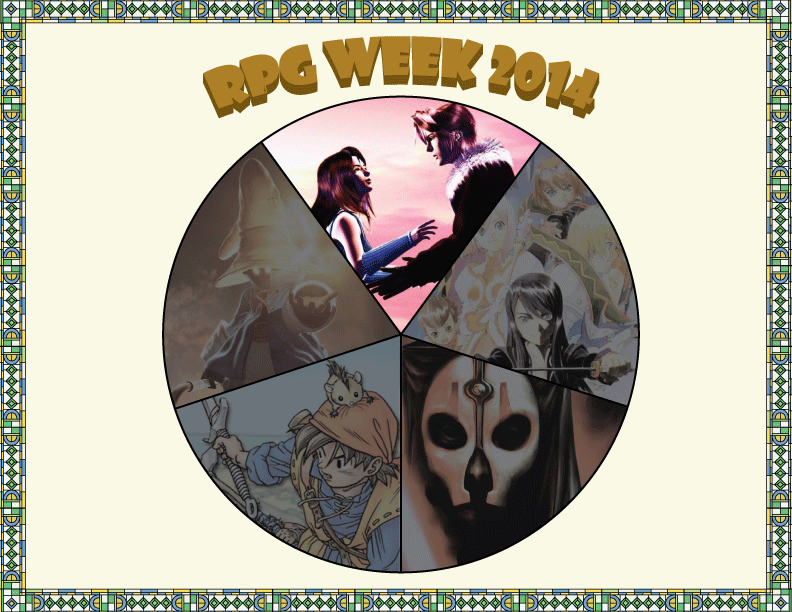
The end of 2014 is soon upon us! So, as I did last year, I intend to relate to you, the ever-so gracious reader, five RPG's that I had the utmost pleasure and excitement playing this past year. Each day until Friday, a new game, and with each comes some history about the game itself, as well as thoughts about my own experience with the game. The role-playing genre in gaming is vast and engrossing, and as you can probably tell, I love talking about some my favourite ones! Consider this all a small Christmas gift to you wonderful folk (perhaps to distract you from my lack of reviews and other such silly things, because of my fervent procrastination...ahem)! So I do hope you check in each day, and I hope you learn a little thing or two!
But of course, on to the main event!
Today's game is Final Fantasy VIII on the original PlayStation. You may or may not remember my bits on Final Fantasy IV and particularly Final Fantasy VII from last year, but this is one that was bound to happen as well! Final Fantasy VIII was released in the West on September 9th, 1999, a full two years after VII, and was the fastest selling Final Fantasy game until only recently. As I hope I mentioned before, each Final Fantasy game, save for ones with a distinct "-2" in their title, are stand-alone entries with varying differences in core mechanics. Meaning, each game is it's own self contained story with its own gameplay focus. Yoshinori Kitase was once again given the task of directing the project, as he did with the two previous entries. The development of VIII aimed for a more realistic feel graphically, compared to the aforementioned VII, and the story was ultimately a noted departure from what fans knew, with a "school-days" feel and aesthetic, compared to the medieval or technological steampunk found before. The graphics received a substantial improvement in the way of character models: now, instead of a range of different character models between the overworld and combat like in VII, each character had one, fully-scaled model used across all situations. The stunning motion cutscenes returned, as did Nobuo Uematsu as the lead composer, and he brought with him another stellar soundtrack, complete with a chart-topping single sung by Chinese singer Faye Wong, "Eyes on Me." As if it needs to be said, I'll get to the soundtrack soon...
FFVIII received substantial improvements to presentation over its predecessor, and yet, it does happen to be one of the more controversial of the Final Fantasy games (well, when you don't count XIII...or the mobile games...or some of the spin off games...or the online games...). In the case of what makes it so mixed opinion-wise, I can see it being boiled down to two prime factors: the story, and the Junction system. Final Fantasy VIII is, at the end of the day, a love story. The great ballad of Squall Leonheart, and Rinoa Heartilly. It is not solely about them, of course, Squall and Rinoa are joined by school mates Zell, a martial-artist, Selphie, an expert of the nunchaku, Quistis, a teacher at their school Balamb Garden, and Irvine, an expert marksman. Their school, Balamb Garden, trains them and their peers to become members of SeeD, an elite group of mercenaries and soldiers, who are hired out to different locations of strife in the world. Through a series of random encounters, Squall meets Rinoa on a mission, and the two begin a relationship that encapsulates much of their respective motivations, and which further story events revolve around. The group also must contend with and learn about visions of a man named Laguna, who as it happens, has some relationship issues of his own.
The Final Fantasy games have always had romantic sub-plots, but to make an entire story revolve around one? It is unusual, especially for long-time fans. I'm sure it divides the fan base on whether or not they like the story...but for myself? I actually quite liked it! It was different, I'll give it that, but it was also not as strange or as thin as I was led to believe. Indeed, there are also plenty of other stories and sub-plots to be found in FFVIII that make it feel like like a familiar title. Squall is certainly a moody protagonist, but he's a character that I felt had some progression, even if it was more subtle. I won't spoil so much of the plot, but let it still be said that there were some great parts that had little to do with either Squall or Rinoa. In fact, the story of Laguna in particular might even be as good if not better than Squall's and Rinoa's! My one issue, however, is that the other supporting characters do not receive as much attention and backstory as I felt they should. That's a huge change of focus from other games, where other party members or characters usually receive a whole section of the game dedicated to their backstory. Those parts are still here, mind, but they're somewhat...lessened, mostly for the focus to be on Squall and Rinoa.
Now the Junction system, yes...a fascinating mechanic.
The Junction system is the "big deal" about the gameplay, which otherwise is quite similar to VII's, in that you have a party of three attack via the Active Time Battle system, with Limit Breaks also returning. The Junction system functions by allowing players to "equip" entities known as Guardian Forces, which are VIII's version of the famous "summons" the series is known for. GF's, like for example Ifrit or Shiva, grant either spells or abilities for the character, while also improving (or diminishing) stats, as well as being able to summon the GF itself. This extends to the use of magic, which also saw a significant change. Magic power/mana is gone, and is replaced by instead stocking different spells individually, acquiring them by "drawing" from different enemies. Basically, any character can use any spell, as long as they have the "Magic" ability from a GF, and any quantity of the spell in question, up to a maximum of 100.
It is, indeed, one of the most unique systems in Final Fantasy, and really any other RPG. It is also, however, one of the most confusing. Trying to learn the best combinations of spells and GF's, as well as constantly switching out certain combinations with different team members, is not only time consuming, but also heavily based on trial and error. That being said, I found it to be an extremely empowering system once I gathered more GF's later in the game, and the battle system is altogether quite excellent. As I said, Limit Breaks are back, and are once again wonderful. They are now randomly received at low health, can select from more than one depending on a character's given weapon, and now have a level of interactivity via timed button presses.
Time to talk about the soundtrack?
Time to talk about the soundtrack.
It's fantastic. It's amazing.
It might also be, in my opinion, one of the best in RPG history. In fact for a lot of people, it was better than the actual game! The hit single "Eyes on Me" is played throughout the game at various parts, and is a great companion piece. But the other incredibly popular theme from the game is the opening cinematic's score: "Liberi Fatali". Damn. There's "Don't Be Afraid," "Force Your Way," and "Maybe I'm A Lion." And oh man, come on, "The Man With the Machine Gun!" Uematsu, at the top of his game! Pure, orchestrated, good times.
Final Fantasy VIII, like VII, is a fairly sizable RPG, with my own total time around 60 or so hours. It follows the usual fair, with a vast world to gradually explore, as well as numerous side activities and quests. One of these is Triple Triad, which is a unique card game that you can play against various people throughout the game world. It's a surprisingly in-depth and elaborate game within a game, involving card-collecting that can also translate into the rest of the game by using certain GF abilities. Bit of a learning curve, but quite cool!
The world itself has some great designs, especially a certain late-game city. The cities and locales are quite extravagant, and still have that...well, that PlayStation feel of pre-rendered backdrops. Haha it's a bit silly, really, but I still think its an aesthetic that looks both unique and memorable! I do think FFVIII has aged a little better than VII, if only because of the character models, but those backgrounds (in both games) are intriguing to me on both a visual and graphical level. The way the game transitions between cutscenes and the game world is fun, if a bit rudimentary, in its own right.
I have a personal story about this game, actually. I'll preface this by saying that the events did occur rather late in the game, although I won't spoil much. At a certain point in the game, you gain opportunities to explore the ocean, and you may explore an off-shore platform in a corner of the map. This facility houses several floors, before extending to a massive underground cavern, that goes deeper beneath the surface. It is within this facility and cavern that you may face multiple enemies, some of which give you powerful Guardian Forces, items and magic spells. Save points are rare, so if you decide to brave the depths, you must be prepared. The prize(s) you can receive by defeating the boss at the end, however, make it very much worthwhile. After entering the facility, you must immediately face a boss, which I did. I was successful, so I left to save, and returned to proceed below. Within the facility, you must use units of energy to power up the various ways leading you the bottom. However, you are only given a set amount of units, and you need a minimum to face the end boss. After facing several more random enemy encounters, I reached a point where I had the opportunity to preserve some of my units involving a party member, Zell, smashing a jammed door. Thinking I'd need all the units I could get, I chose to do so. The door led deeper into the caverns, so I thought it would be a good idea to go and save the game, so I went back to the save point and overwrote the current save slot.
This would prove to be a significant mistake.
I returned to the entrance I had just opened, and proceeded down. Not two steps did I take before I was thrust into what I thought was a random enemy encounter. The encounter was against a set of enemies of which were not terribly difficult, but were time consuming to take out, and could leave annoying status effects on my party. Tough luck, I thought. I finished the battle, and took a few more steps before encountering another battle. I uttered a bad word. Battle complete, I continued down the steps. Just then, another battle. At this point, the madness was real. This was arduous, and ridiculous. I had barely moved around. What the hell was going on? I consulted a handy wiki to make sense of this crap, and was horrified to find out what I had done. By having Zell smash the door, I unknowingly changed the way monsters would appear in the cavern. Essentially, unlike the random encounters I faced every little while above the surface, every battle below here was scripted, and had to happen. And these scripted battles occurred almost immediately after one another, after I took several steps in-game. This was not a good situation, as I feared how long it would take to reach the bottom. And to seal my fate, I realized I had overwritten the save file that could have prevented this. The other save file I had? It was 20 hours previous. Not gonna replay all of that.
Well...shit.
I decided to do it. To commit. To brave the struggle and fight my way to the bottom.
It took me one hour. One hour to reach the bottom. If I had no enemy encounters, it could have taken me a couple of minutes to reach the bottom. But with all the scripted encounters? One hour. Oh, but we're not done.
At the bottom, there was no save point. At least, there was none I could activate. So this was it. Balls to the wall. All or nothing. This was where the fruits of my labour would be made apparent. The end boss is a creature known as Ultima Weapon. Yes, that is the name. It's a behemoth. It is an optional boss. And it is, I think, as difficult if not more so then the final boss of the entire game. Using the "Draw" command, a party member can extract from Ultima Weapon the single most insane, dramatic and powerful Guardian Force in the entire game, Eden. When I say powerful, I mean, freaking powerful. Seriously, watch that video.
The battle begins. I immediately lose party members left and right, and am only saved by some quick healing and resurrection. I felt like it would be a long process of slowly widdling away at the boss's health, all while making sure I can heal/resurrect party members. Ultima Weapon has an occasional attack that effectively decimates every party member, pretty much guaranteeing a death. The Limit Breaks are a saving grace to be sure.
But...he got me.
I lost the battle.
It had barely just begun.
In one gigantic attack, I lost everybody at once.
Game Over.
That was a defeat of the most enraging variety.
I was not going to give up, however, so I regrouped and moved around some Junctions, making some adjustments. I decided to immediately try again. Another hour, spent getting to the bottom.
A slightly easier trek, I must admit, since I had went and gained a few levels outside the facility before trying again. I also got a bit smarter with the Junctions, so that assuredly would have helped. I had a new strategy this time, focusing on different party members and different abilities. I proclaimed I would not lose again.
I do battle with Ultima Weapon once more. This battle is drawn out tremendously. Many close calls, but I was able to resurrect quickly, and keep some members with limit breaks. I did not have the other best Guardian Forces at the time, nor did I have other powerful spells, but I did have one thing: Squall's best weapon, Lion Heart. It allows for the best limit break, next to maybe Rinoa's, and can be a force to reckoned with when used after various effect spells...something I neglected the first time. It wasn't an easy battle, but between Speed, Limit Breaks, and some lucky heals...
I beat him.
I defeated Ultima Weapon.
Victory was mine...
That is, until I realized I had made a crucial error, and had forgotten to draw Eden from Ultima Weapon. I...was not happy. Not at all. I shut the game off for the day, and walked away. Of course, the next day, I had to try again. And so I did.
Everything I said previous? It applies once more. An entire hour of my day, dedicated to getting to the bottom, with no save points in between.
Yet again, the rumble calls to battle between myself and Ultima Weapon. Another hour spent getting here. I had won before, and I knew what to do. One close call at the beginning was not enough to deter me. Of course, I had not forgotten to draw Eden, and I did so at a cost of a turn, and a near death. Yet, I came back. And I let loose all hell on Ultima Weapon. And as if by some sheer poetic justice, I finished off Ultima Weapon for a SECOND TIME with Squall's limit break, Lion Heart. It was utterly, utterly epic. With the final swing of his limit break, Ultima Weapon was no more.
I had won.
And I had Eden.
That...was immensely satisfying.
I don't know if the other entries this week will take this long to read (or write, haha), but I hope you liked the story here. So...Final Fantasy VIII? I think it is profoundly underrated. An excellent game, that is perhaps overshadowed by its other fellow PlayStation entries. However, yes, I understand why this game has seen so much division over the last decade and a half. And yet, when I finally finished the game, it brought a wonderful sense of accomplishment and satisfaction. Something I was not wholly expecting, I will admit. I came into FFVIII with some middling expectation, but I found a quite surprisingly stellar game to be had instead.
Tuesday, February 11, 2014
Donlevy Reviews Ico & Shadow of the Colossus!
Welcome welcome, fellow people! If you're coming from Tumblr, or anywhere else, be sure to check out my introduction earlier in the blog! And as always, thanks for checking this all out! I hope you enjoy the premiere review on this blog!
As I teased through Tumblr, I do in fact have a double helping of game reviews for you today! Consider it payment for my missing of the previous content days. The two games in question are Ico and Shadow of the Colossus, both of which can be found remastered on one wonderful disc for the PS3, as shown above (which also features the FAR superior European/Japanese Ico boxart. The North American one is just terrible.). The games were originally released on the PS2 in 2001 and 2005, respectively, and both share many similarities, as well as Shadow of the Colossus being a spiritual prequel of sorts to Ico. Both games make wonderful use of simplicity and minimalist design to showcase the world and respective game mechanics, as well as allow the player to piece together and elaborate upon the stories at their own behest. These are wonderful games, and are a testament to the power of the PS2, as well as the magnitude for interactive storytelling. Absolutely two of the most defining puzzle games in video game art, and each hold up remarkably well in the new and awesome HD collection for the PS3. But I know you...oh yes, you want details, do you not? Very well then.
Quick note: I'm only using one Donlevy Spectrum (trademark still pending), and that will be for both games together, since their overall positives and negatives are largely similar. Newcomers: yes indeed, I use a Spectrum for reviewing!
Ico
Ico involves very little backstory: you play as the young boy Ico, after he is lead into a prison-like castle by members of his village, for the sole reason of possessing horns upon his head. As you begin to explore after breaking free, you come across a mysterious young girl named Yorda, whom Ico is unable to understand when she tries to speak. Regardless, you control Ico as you quite literally guide Yorda through the castle, attempting to find a means for the both of you to escape the vast castle grounds. Along the way however, eerie shadow-like figures emerge to try and recapture Yorda, and you must defend her with Ico's weapon, either a plank of wood or, eventually, a sword. Failure to do so results in a Game Over, and a transport back to one of your last saves, which take the form of strange stone benches found in various locations throughout the castle. To help Yorda move and advance through the castle, your duty is to solve the various puzzles that make up the areas, usually involving climbing and jumping, or the moving of certain objects.
And as you solve the puzzles and progress through the castle, you'll begin to form a unique story of it all, almost entirely implicitly. The castle and the land is mysterious and haunting, with an isolated yet disturbed feeling that echoes throughout the chambers and courtyards. Ico specializes in a minimalist philosophy for it's setting, and everything from the fog from beneath or the broken statues and benches contributes to a really unique and fascinating atmosphere. As a game from 2001, the game still holds up well graphically, and the HD update goes a long way to pushing the lighting and emphasizing colour. There isn't a lot of music to speak of, apart from the AWESOME credits song, as much of the sound design comes in the form of ambience and sound effects, but it goes a long way towards the setting and tone.
So apart from some frustrating controls and camera, and some annoying misdirection, Ico is a special game with a wonderfully unique narrative and setting, and some intensely satisfying moments that last even past the end. It was something of a hidden gem during the PS2 days, but now with this HD Collection, Ico truly gets to shine as an early and stellar example of art direction within a game. Very cool indeed.
Shadow of the Colossus
Similar to Ico, the backstory to Shadow of the Colossus is short and simple, but a bit more elaborate. You play as Wander, a young man who has fled his village with his horse Agro, and the body of his beloved, Mono, after she was sacrificed in a village ritual. Wander ventures to a mysterious and forbidden land far beyond his home in a bid to resurrect Mono with the help of the deity Dormin, no matter the cost. To do so requires the death of sixteen Colossi that inhabit the vast land, and with Agro, Wander sets out to find and eliminate the various Colossi.
You have at your disposal a bow with unlimited arrows, as well as an invaluable sword which directs you to the next Colossus via the reflecting of sunlight. Before leaving the shrine to find them, Dormin will leave you with a
hint and slight description (in the form of an idol) about the next
Colossus to defeat, and the cryptic and cool nature leaves you guessing
in anticipation. Reaching each respective Colossus can range from simply finding the closest path, or past a series of complex platforms and jumps (a la Ico). Finding the correct path can sometimes be a hassle, as the sunlight sometimes directs you to an area in which a path is not immediately observable. Finding the Colossi is a puzzle unto itself, and I certainly found it enjoyable thanks to the aforementioned fun of travel, even if it was sometimes quite befuddling. But the bulk of this games awesome nature comes in the form of taking on each respective, and quite varied, Colossi. Each Colossus require a different strategy to take down, each themselves a puzzle, but the one common element found throughout the massive battles is climbing. I mean, you'd be pretty useless if the only thing you could do in the game was shoot petty arrows at these behemoths. As I mentioned before, you have a Grip gauge, or rather a Stamina gauge, and you are at it's mercy as you climb a Colossus in search of their weak points, where you must then use your sword to bring them down. Holding on to fur or ledges slowly decreases the gauge, as does minor things like firing the bow and swimming (yes, there is a terrifying water-based Colossus), and if your gauge runs out, well: *pheuuuuuuuuuuuuuuuuuuuuuuuuuuuuuuuuuuuuuuuuuuuuuu splat*. Climbing and figuring out how to take down each respective Colossi is fantastic fun, and every single fight feels like a tremendous boss battle on an epic scale, and solving the puzzle of the Colossus and taking them down is a wonderfully satisfying feeling. These are truly memorable fights, and each of the Colossi exhibits different habits and dispositions; some are indifferent to Wander, while others are fiercely aggressive, and it makes the Colossi feel more unique and mysterious than simple enemies.
Compared to Ico, the soundtrack to Shadow of the Colossus is much more bombastic and epic to fit with the battles and triumphs. Nary but the sound of wind can be heard when exploring the world, but in a fight, the music changes dynamically to what's happening in the battle. As Wander approaches the Colossi, or maintains his distance, the music is tense and daunting, but when Wander begins to climb the Colossus, the music changes to a sweeping and hugely awesome triumphant score. Because I can, hear one of the tracks in question here: BOOM LINK. Also with Ico, Shadow of the Colossus holds up great as part of the HD Collection. The lighting and spectacular shadows that can also be found in Ico continue to add and enhance the atmosphere and design, and the aesthetic of the Colossi is still fantastic, as it really comes through in High Def. There's a slight film grain effect which kind of shows it's age, but for the rest of the game, I have no complaints.
So yeah, Shadow of the Colossus kicks all leagues of butt. It's a memorable and intensely satisfying adventure with a vast and haunting world to explore, a minimalist aesthetic that enhances everything, and a simple story that, like Ico, leaves much to the player while still including many various details. The gameplay in the Colossus fights is stellar and engaging, and while it shares Ico's problem of having a trying camera and some finicky and unreliable controls, it was never unplayable or repulsive. An amazing experience.
And as a summary, Ico and Shadow of the Colossus are simply glorious. Actions speak louder than words, and both games present fantastic stories and adventures whilst speaking on only a handful of occasions in each case. The use of minimalism enhances the two in ways that were quite groundbreaking at the time, and now it makes them some of the best games that combine artistic expression and excellent gameplay, as they leave lasting impacts on those who play them. Having both Ico & Shadow of the Colossus together in HD for a new generation is a wonderful thing, and I highly encourage you to give them a look.
YAY
As I teased through Tumblr, I do in fact have a double helping of game reviews for you today! Consider it payment for my missing of the previous content days. The two games in question are Ico and Shadow of the Colossus, both of which can be found remastered on one wonderful disc for the PS3, as shown above (which also features the FAR superior European/Japanese Ico boxart. The North American one is just terrible.). The games were originally released on the PS2 in 2001 and 2005, respectively, and both share many similarities, as well as Shadow of the Colossus being a spiritual prequel of sorts to Ico. Both games make wonderful use of simplicity and minimalist design to showcase the world and respective game mechanics, as well as allow the player to piece together and elaborate upon the stories at their own behest. These are wonderful games, and are a testament to the power of the PS2, as well as the magnitude for interactive storytelling. Absolutely two of the most defining puzzle games in video game art, and each hold up remarkably well in the new and awesome HD collection for the PS3. But I know you...oh yes, you want details, do you not? Very well then.
Quick note: I'm only using one Donlevy Spectrum (trademark still pending), and that will be for both games together, since their overall positives and negatives are largely similar. Newcomers: yes indeed, I use a Spectrum for reviewing!
Ico
Ico involves very little backstory: you play as the young boy Ico, after he is lead into a prison-like castle by members of his village, for the sole reason of possessing horns upon his head. As you begin to explore after breaking free, you come across a mysterious young girl named Yorda, whom Ico is unable to understand when she tries to speak. Regardless, you control Ico as you quite literally guide Yorda through the castle, attempting to find a means for the both of you to escape the vast castle grounds. Along the way however, eerie shadow-like figures emerge to try and recapture Yorda, and you must defend her with Ico's weapon, either a plank of wood or, eventually, a sword. Failure to do so results in a Game Over, and a transport back to one of your last saves, which take the form of strange stone benches found in various locations throughout the castle. To help Yorda move and advance through the castle, your duty is to solve the various puzzles that make up the areas, usually involving climbing and jumping, or the moving of certain objects.
Ico offers practically no "hand-holding" to the player (rather ironic given that that's the main mechanic of the game) and despite a sometimes linear path, leaves it up to you to explore the castle and discover what to do. This is largely one of the best aspects of the game, in that it makes success all the more satisfying when you complete a task. However, it can lead to unruly frustration at times, and particularly at the beginning, it can drain the desire out of any new player. See, with a game like Ico where so little is directly revealed to you, both in story and in gameplay, it can feel like there is lack of incentive at the beginning to continue past the immediately tricky or obtuse puzzles. In this, it does require a lot of the player, and it makes Ico somewhat demanding, but it absolutely is worth seeing to the end, despite the reticent structure. Lack of direction or directive can eat up your time playing this game, and while it's admirable, it can be a real pain when the solution or path is hindered by either the camera or misdirection. Indeed, there are more than a few environmental "red herrings" of sorts that can throw you off your course. Boxes that can be moved, and some that can't. A long corridor that leads to nowhere in particular. It's all part of the fun of exploring, but Ico is not impervious to annoyance. And it doesn't help that the controls and camera are far from perfect. The controls are very sensitive, with Ico sometimes jittering and falling over an edge with no intent, or jumping off a (very high) ledge by mistake. And with the camera, the placement and tricky depth of field can mask your task, or just make a jump a little too difficult. Still, the rest of the puzzles are very well designed, and never require too much from the player, as you have an intentionally limited number of actions to take at any given time, and you'll understand what you need to do. If progress is ever hindered, you will get through it eventually.
So apart from some frustrating controls and camera, and some annoying misdirection, Ico is a special game with a wonderfully unique narrative and setting, and some intensely satisfying moments that last even past the end. It was something of a hidden gem during the PS2 days, but now with this HD Collection, Ico truly gets to shine as an early and stellar example of art direction within a game. Very cool indeed.
Shadow of the Colossus
Similar to Ico, the backstory to Shadow of the Colossus is short and simple, but a bit more elaborate. You play as Wander, a young man who has fled his village with his horse Agro, and the body of his beloved, Mono, after she was sacrificed in a village ritual. Wander ventures to a mysterious and forbidden land far beyond his home in a bid to resurrect Mono with the help of the deity Dormin, no matter the cost. To do so requires the death of sixteen Colossi that inhabit the vast land, and with Agro, Wander sets out to find and eliminate the various Colossi.
Embarking from a central shrine, the entire landscape opens up for Wander and Agro to travel to. The area is vast in both scale and scope, and while much of this game will indeed be spent travelling around, it is never dull. The areas are varied and serene, but yet very isolated, and it adds to a haunting and scenic journey wherever you go. Crossing a narrow path alongside a mountain only to peek down at the enormous lake below is a marvellous sight, and it is at times like these where the game feels majestic and wondrous, and a bond is formed with Agro, your only companion along the way. Controlling Agro across the land is very tricky at first, as you have to adjust to different speeds for different occasions, and it can be frustrating to control Agro by an edge, but eventually the controls will be learned enough to perform a few useful tricks as you gallop across the land. There are different, but subtle, secrets to uncover as you go around, such as different save shrines, or collecting food and shining lizard tails that improve your health and Grip gauge (which will be mentioned shortly). These secrets are easy to miss, but along with a time trial mode and several other unlockables, these add to the gameplay and replayability by a good margin.
Compared to Ico, the soundtrack to Shadow of the Colossus is much more bombastic and epic to fit with the battles and triumphs. Nary but the sound of wind can be heard when exploring the world, but in a fight, the music changes dynamically to what's happening in the battle. As Wander approaches the Colossi, or maintains his distance, the music is tense and daunting, but when Wander begins to climb the Colossus, the music changes to a sweeping and hugely awesome triumphant score. Because I can, hear one of the tracks in question here: BOOM LINK. Also with Ico, Shadow of the Colossus holds up great as part of the HD Collection. The lighting and spectacular shadows that can also be found in Ico continue to add and enhance the atmosphere and design, and the aesthetic of the Colossi is still fantastic, as it really comes through in High Def. There's a slight film grain effect which kind of shows it's age, but for the rest of the game, I have no complaints.
So yeah, Shadow of the Colossus kicks all leagues of butt. It's a memorable and intensely satisfying adventure with a vast and haunting world to explore, a minimalist aesthetic that enhances everything, and a simple story that, like Ico, leaves much to the player while still including many various details. The gameplay in the Colossus fights is stellar and engaging, and while it shares Ico's problem of having a trying camera and some finicky and unreliable controls, it was never unplayable or repulsive. An amazing experience.
And as a summary, Ico and Shadow of the Colossus are simply glorious. Actions speak louder than words, and both games present fantastic stories and adventures whilst speaking on only a handful of occasions in each case. The use of minimalism enhances the two in ways that were quite groundbreaking at the time, and now it makes them some of the best games that combine artistic expression and excellent gameplay, as they leave lasting impacts on those who play them. Having both Ico & Shadow of the Colossus together in HD for a new generation is a wonderful thing, and I highly encourage you to give them a look.
Ico & Shadow of the Colossus
YAY
- Fantastic, haunting, and immersive atmosphere and aesthetic for both games.
- Able to tell so much with so little.
- Challenging, varied, and wonderfully fun puzzles.
- Each game is incredibly satisfying all the way to completion.
- Limited camera angles frequently work against the player.
- In Ico's case, lack of any instruction can lead to early frustration.
- Imprecise controls can result in avoidable mistakes.
Labels:
art,
awesome,
Donlevy,
games,
gaming,
Ico,
PlayStation,
PS3,
review,
Shadow of the Colossus,
video games
Subscribe to:
Posts (Atom)